
Last week my friend and fellow teacher Nicole Cutler messaged me about a reel that had turned up on her Instagram feed. Nicole is a former World Amateur Latin champion, and she writes her own blog, at nicolecutler.com, where she speaks out about issues in the dance world that need talking about. I haven’t stopped thinking about the reel since.
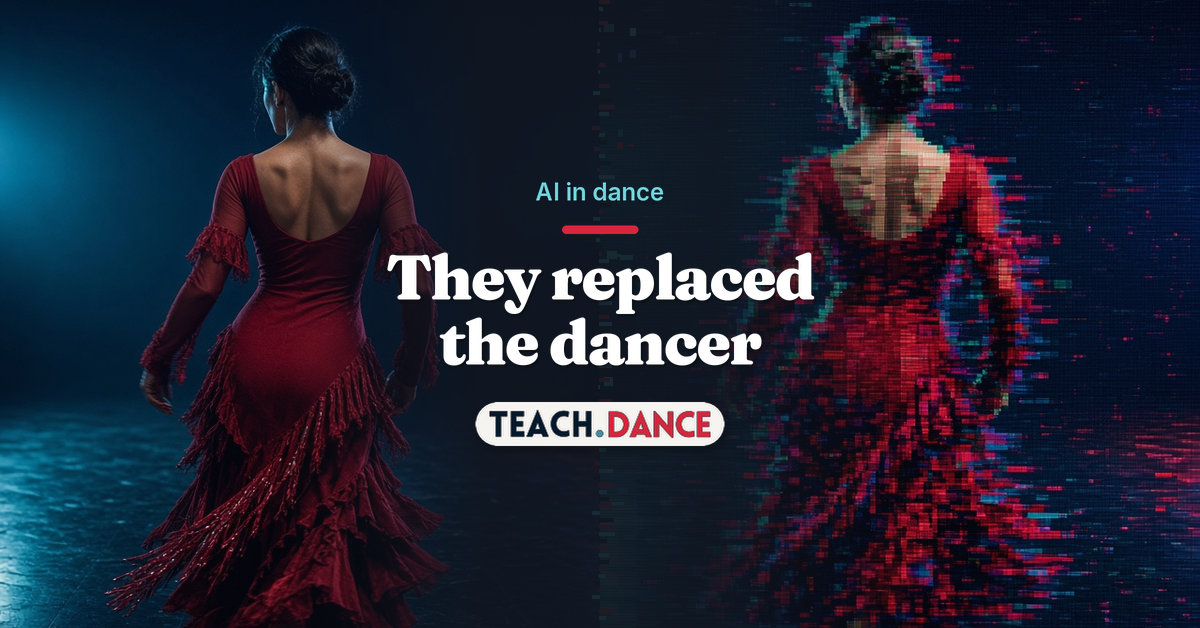
It was a Latin routine. The footwork, the timing and the partnering all belonged to a real dancer. But the account that posted it, which as far as we can tell is run by AI, had swapped her out for an AI-generated version of its own persona. The real dancer asked about it in the comments. She didn’t get a reply.
I’m not naming or linking the account, because the last thing it needs is more views.
“I wondered how long it would take”
Nicole wasn’t surprised, and that’s what worried her most. “I wondered how long it would take for something like this to happen publicly, never mind what happens where we can’t see it,” she told me.
She also pointed out that every dancer who puts themselves out there faces the same risk, whether they posted the footage themselves or it was filmed by a photographer or videographer at an event. No permission is asked, and none seems to be needed.
I’d already seen something similar on the street dance circuit, but this was the first Latin one I’d come across. What struck me most is how fast it’s moving.
More than a stolen video
For Nicole, this goes further than copyright. “It’s a form of identity theft,” she said. Dancers spend a lot of time and money on their dancing, and all of that can be taken away in an instant: the person they are, and their image, used by someone else for their own gain.
I think about what goes into a competitive routine: years of lessons, coaching, costumes, travel and entry fees. A stranger can now take the finished result and present it as someone else’s dancing in minutes.
When Nicole reported the reel, there was no option for identity theft, so she chose fraud. The platform came back to say it didn’t violate its terms.
Where could this go?
This reel is one example. The questions it raises are much bigger, and I think we need to start asking them now, while there’s still time to shape the answers.
If a body can be swapped, what does a performance prove? Dance has always been the one art form you can’t fake. You either did the work or you didn’t. If any routine can be copied onto any face or body, what happens to the value of a dancer’s online showreel? Will a casting director, a coach or a partner looking for a new partner trust a video at all?
Who owns a dancer’s movement? As I understand it, UK law doesn’t give you a general right over your image or the way you move. A recorded routine can be protected as choreography, and dancers have some rights in recordings of their performances, but that isn’t the same as owning your likeness or your style. A face-swap like this one can sit in a gap the law hasn’t fully closed. The government has said that existing protections don’t cover every case where someone’s likeness is copied without permission, and it is looking at whether a new right is needed.
What happens to competition footage? Every weekend, thousands of dancers are filmed at competitions, often by official videographers and often by parents in the audience. All of it is raw material. Do we carry on filming everything, or start thinking differently about who films and where it goes?
What about children? The big AI tools usually say they restrict images of children, or apply tighter checks when a child appears, especially anything sexual. That isn’t the same as a reliable block. Safeguarding bodies have already warned that ordinary photos and videos of children can be taken and altered, and the Internet Watch Foundation has shown that this is happening. There are also tools that don’t have those safeguards at all. Children’s footage is shared every weekend, usually by people with the best intentions, and that is the bit that frightens me most.
Could AI dancers replace real ones? If an account can build an audience with a dancer it stole, how long before brands, music videos and adverts decide they don’t need real dancers at all? That affects the careers we’re training our students for.
And the harder question: is any of it useful? I don’t want to pretend AI is only a threat. It could help with lesson planning, cutting music, analysing technique or making dance more accessible. We need to be honest about both sides if we’re going to make good decisions.
So whose job is it?
Is it enough for event organisers to warn people to be careful about how their pictures and videos are shared? Or should we all be doing more?
Nicole thinks the responsibility is shared. Videographers and photographers have a part to play, as do organisers and dance associations, at least in making people aware of the very real consequences. “They’re not even possibilities anymore.”
I agree, and I’d add teachers to that list. We’re often the first people our students and parents ask, and we need to be ready with answers.
Nicole is also clear that this conversation needs to happen now, because it already has.
What you can do now
Talk to your students and parents. Explain that anything posted publicly can be reused, and that AI makes it easier.
Check your photo and video consent forms. Do they say what the footage will be used for, where it will be shared and who can see it? Do they explain how long you’ll keep it, and how a family can change their mind? It’s also worth telling families, in plain terms, that once an image is public it can be reused or altered, including with AI. Our guide to dance school data protection walks through consent and safer sharing in more detail.
Think before you post. Consider private groups or unlisted links for children’s routines rather than public reels.
Report it. If you find a dancer’s footage being misused, report the post on the platform, keep a record of what you sent and any reply you get, and tell the dancer. Platforms may not have a category that quite fits, as Nicole found, and they may still decide it doesn’t break their rules. Sharing, commenting or even viewing the post only feeds the algorithm, which is another reason not to give accounts like this any extra attention.
This is the start of our AI in dance series
I don’t have all the answers, and I don’t think anyone does yet. So over the coming weeks, we’ll dig into these questions one at a time:
- What event organisers, photographers and videographers should be doing
- Children, images and AI, and whether your consent forms are still fit for purpose
- What a dancer or teacher can actually protect, from image to choreography
- Whether AI could ever replace the dance teacher
- AI music in class and on stage
Some of it will be practical and some of it will be uncomfortable. All of it will be written for teachers.
Over to you
Have you seen your dancers’ footage reused or altered? Do you think organisers should be doing more? I’d really like to hear from you.
Jess Porter






Responses