
Dance school assistants: pay and safer recruitment

Every dance school has one. The 14 year old who arrives early for Saturday baby ballet and helps the little ones with their shoes. She knows every song by heart. Young dance school assistants are often our future teachers, and giving them a role is one of the nicest ways to grow your own team.
Setting that role up properly keeps everyone safe and shows parents you take welfare seriously, for your youngest dancers and for your assistant. This guide covers volunteering, the rules on employing children, pay and safer recruitment. This is general guidance, not legal advice. For your own situation, check gov.uk, your local council or get advice.
Volunteer or paid helper?
The first question is how you’ll thank your helper. The gov.uk page on volunteer pay and expenses explains that volunteers aren’t paid for their time, but may get money to cover expenses. That’s usually limited to food, drink, travel or equipment they need to buy.
Here’s the part that matters for dance schools. Gov.uk says someone might be classed as an employee or worker, rather than a volunteer. That can happen if they get any other payment, reward or benefit in kind. That includes any promise of a contract or paid work in the future. Employees and workers get certain employment rights, such as the minimum wage.
Perhaps your assistant helps in return for free classes, or a discount on their own lessons. It’s worth thinking about whether that counts as a reward. If you’re unsure, get advice before you agree the arrangement.
Employing children under school leaving age
If you pay a helper who is still of compulsory school age, the child employment rules apply. The gov.uk guide to child employment says children can work part-time from the age of 14. In some local council areas, they can start at 13. It’s best to contact your local council’s education department or education welfare service to check.
Hours and breaks
There are clear limits on when children can work, set out in gov.uk’s restrictions on child employment. Children aren’t allowed to work during school hours, before 7am or after 7pm. They also can’t work for more than 4 hours without a break of at least 1 hour. Each calendar year, they need a 2-week break from any work during the school holidays.
In term time, children can work a maximum of 12 hours a week. That includes:
- a maximum of 2 hours on school days and Sundays
- a maximum of 5 hours on Saturdays for 14 year olds
- a maximum of 8 hours on Saturdays for 15 and 16 year olds.
During school holidays, the weekly limits go up:
- 14 year olds: up to 25 hours a week
- 15 to 16 year olds: up to 35 hours a week.
Those limits matter if your assistant helps at a holiday intensive or summer school. Local bylaws can add other rules too, so check with your council.
Child employment permits
Most local councils say businesses must apply for a permit before employing school-aged children. Gov.uk explains this on its page about local council rules for child employment permits. It also notes that if a child works without one, there’s a risk the employer won’t be insured against accidents involving the child. A quick call to your council’s education welfare service is the easiest way to find out what it needs.
Paying young assistants aged 16 and over
Once a paid assistant reaches school leaving age, they’re entitled to the National Minimum Wage. The gov.uk page on minimum wage rates lists these hourly rates from April 2026:
- 21 and over: £12.71
- 18 to 20: £10.85
- under 18: £8
- apprentice: £8.
The rates change on 1 April every year. Gov.uk also notes that once someone reaches 16, you may need to pay them through PAYE. Young workers have their own limits on hours too. The gov.uk guide to maximum weekly working hours covers this. If you’re under 18, you can’t work more than 8 hours a day or 40 hours a week.
Safer recruitment for helpers
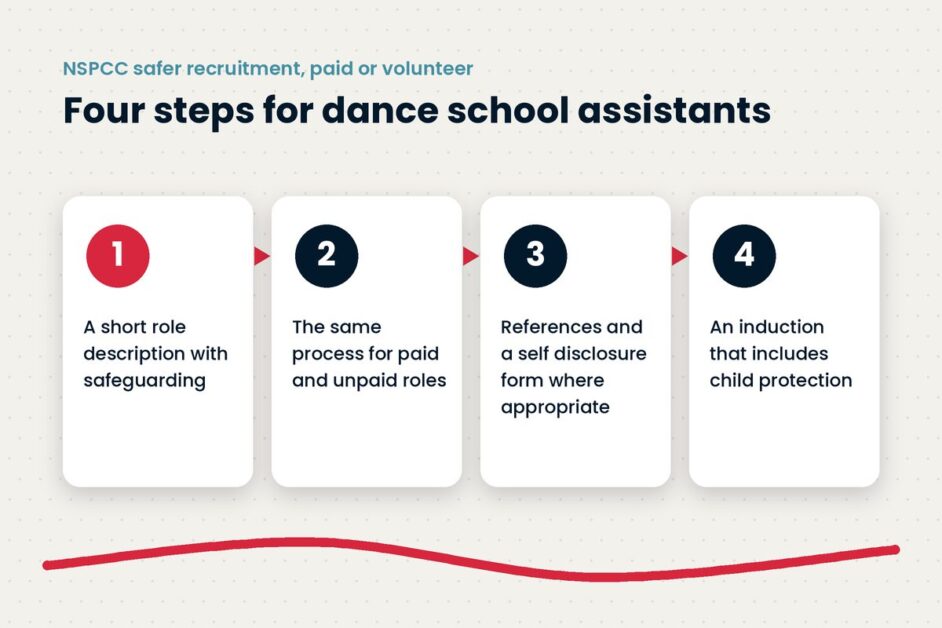
Whether your assistant is paid or a volunteer, the same safe habits apply. The NSPCC’s guidance on safer recruitment applies to every school, club or business whose work involves contact with children. It suggests a few simple steps that work well in a dance school:
- a short role description that includes safeguarding responsibilities
- the same application process for paid and unpaid roles
- references, and a self-disclosure form where appropriate
- an induction that includes child protection.
A clear role description also helps your assistant. They know what they can do, such as leading a warm-up or helping with costumes, and when to come and find you.
DBS checks and young assistants
The DBS guidance for employers says the minimum age at which someone can be asked to apply for a criminal record check is 16. So a helper under 16 can’t be checked. That’s where a clear role and good supervision come in, keeping your youngest dancers and your assistant safe.
For helpers aged 16 and over, there’s some good news this term. From 1 September 2026, the law removed the supervision exemption from regulated activity with children. Put simply, more regular helpers can now have the highest level of DBS check. The Department for Education’s guidance on removing the supervision exemption covers volunteers. It explains that volunteers in regulated activity now need an enhanced DBS check with children’s barred list information. Activity counts as regulated if it’s done frequently, on more than 3 days in any 30-day period, or overnight. The DfE also notes that DBS checks for volunteers are free. Its guidance is written for schools, colleges and childcare settings, so check how it applies to your setting.
Need a route for DBS checks? Our partner, the British DanceSport Association (BDSA), lists a DBS checking service in its Dance Schools & Studios membership. It’s worth a look if you’re checking several helpers.
Helping assistants grow into teachers
The best assistant roles feel like the first step into teaching. Give your helper small responsibilities that build over time, like counting in a routine, demonstrating a step or running the register. Talk with them after class about what went well.
Your own safeguarding knowledge matters here too. As the adult in charge, you might find the Teach.Dance Introduction to Safeguarding in Dance (Level 1) course a useful refresher. It’s a short introductory online course on spotting concerns, responding and reporting, and safer practice. It helps you guide your assistant with confidence.
When your assistant is ready to think about teaching for real, our guide to becoming a dance teacher is a good next read.
Quick FAQ
Can a 13 year old help in my classes?
For paid work, gov.uk says children can usually work part-time from 14, and from 13 in some council areas. Check with your local council’s education welfare service. Whatever the arrangement, give them a clear role and good supervision.
Do I have to pay my 15 year old assistant the minimum wage?
Gov.uk says you must be at least school leaving age to get the National Minimum Wage. The child employment rules on hours, breaks and permits still apply if you employ them.
Can I give free classes instead of pay?
Gov.uk says volunteers who get a payment, reward or benefit in kind might be classed as employees or workers. Free classes could fall into that, so get advice before you agree it.
What’s a good first step?
Write a short role description for your assistant, covering what they can do and when to come and find you. It helps them, and it shows parents you’ve thought it through.
Teach.Dance · For Teachers, By Teachers





Responses