
If you’ve ever put a House track on at the end of class, you’ll know what happens. Feet start moving, shoulders drop and even your quietest dancers begin to bounce. That’s why our House dance course for teachers is this month’s course spotlight.
House is joyful, social and made for freestyle. That makes it a brilliant style for street, commercial or end of term classes. Here’s what’s inside the Street Dance House Foundations Mini Course, who it suits and a few ideas to try in class straight away.
Where House comes from
House music grew up in Chicago. The City of Chicago’s page on The Warehouse becoming a Chicago landmark describes the club as the birthplace of house music. It ran from 1977 to 1982, and its resident DJ, Frankie Knuckles, drew on disco, R&B, gospel and techno.
The sound was embraced by Chicago’s Black and Latinx LGBTQ communities, and by the end of the 1980s it was popular around the world. That history matters in the studio. House grew on club floors, so the groove comes first and the steps follow. Sharing a little of the story helps dancers respect the style and dance it with real character.
Why House matters for street dance teachers
House is one of the main foundation styles under the street dance umbrella, so a proper understanding of it really helps. It gives your regular street and commercial classes a stronger base, because the groove, the bounce and the footwork feed into so much of what you already teach. And if you enter children in street dance competitions, a grounding in the foundation styles gives them more to draw on in their routines and when they freestyle.
What the course covers
The course is taught by Ess Green, founder of Street Dance Training, which partnered with Teach.Dance in 2024 to bring street dance courses and video content to our members. Ess has a warm, friendly personality, which makes this a relaxed place to start if House is new to you.
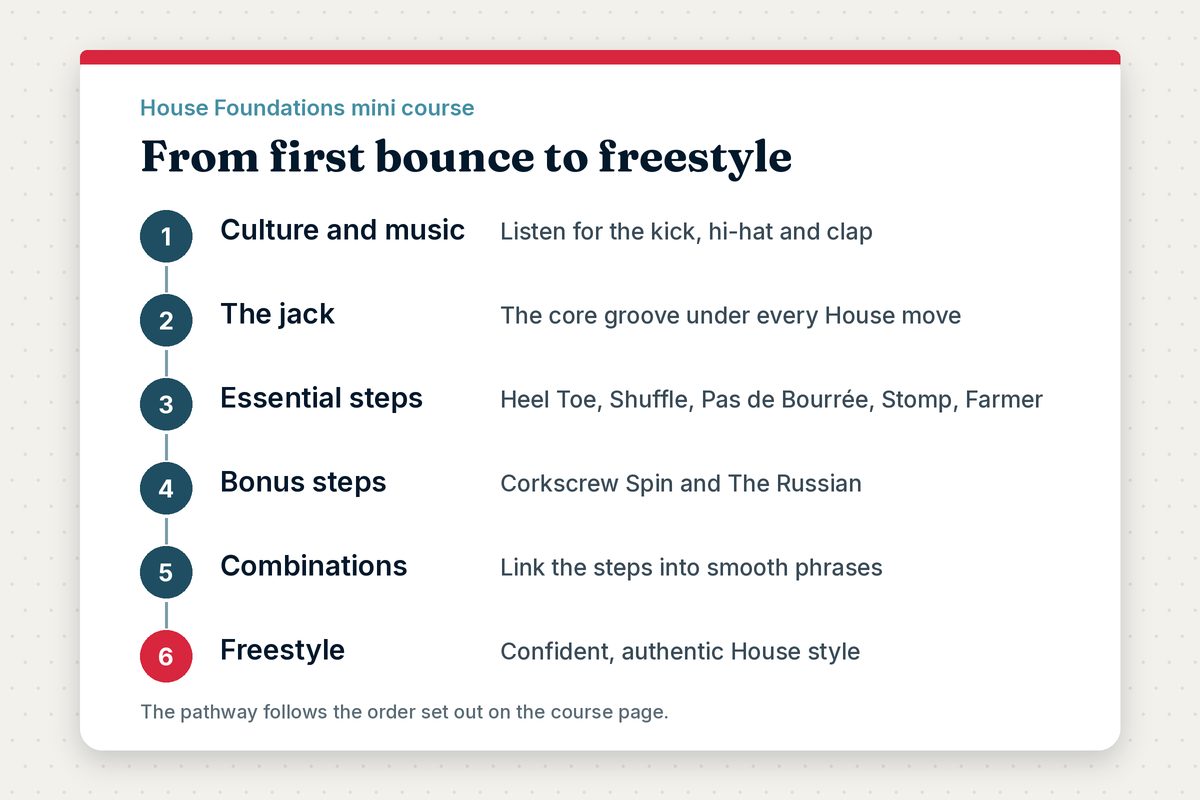
The House Foundations mini course is beginner friendly and works as a clear pathway, from the first bounce to confident freestyle. Here’s how it builds, in the order the course page sets out:
- Culture and music. Where House comes from, and how to help students tune in to the rhythm by listening for the kick, hi-hat and clap.
- The jack. The core groove that underpins all House movement.
- Essential steps. The Heel Toe, Shuffle, Pas de Bourrée, Stomp and Farmer, each explained step by step with simple variations for different levels.
- Bonus steps. The Corkscrew Spin and The Russian, to keep things fresh.
- Combinations and freestyle. How to link steps into smooth combinations that lead naturally into freestyle.
By the end, you should be able to share the history and culture of House in class. You’ll teach students to move with the music and feel the groove, and break down and adapt the key steps. You’ll also add creative variations and build combinations that lead into freestyle.
Three ideas to try in your next class
While you work through the course, here are a few simple ideas of our own. They’ll get House into your classes this week.
Find the kick
Play a House track and ask dancers to bounce gently on every kick drum. Then add a clap on the clap. It sounds simple, but it trains the ears first, and that’s where good House starts. Younger dancers love turning it into a listening game: freeze when the kick drops out.
Jack in a circle
Stand everyone in a circle so nobody is at the back. Groove together for eight counts, then let one dancer change the groove while everyone copies. Keep the bounce soft and the knees relaxed. It builds confidence without anyone being in the spotlight for long.
Step swap
Teach two steps, say the Heel Toe and the Stomp. Dancers do four counts of each, then swap the order, then choose their own order. It’s freestyle with stabilisers, and a lovely bridge for dancers who freeze when you say “just do your own thing”.
Who it’s for
The course is written for working dance teachers. That includes school owners who want to train themselves and their team, and freelance teachers who want to add a new style. It also suits assistants and newer teachers building their knowledge alongside the teachers they work with.
You don’t need to be a House specialist to start. If you already teach street or commercial, it gives you a proper foundation in a style dancers often ask for. If you mainly teach theatre styles, you’ll spot familiar ground in the Pas de Bourrée, with a very different feel.
Prices and how it works
There are four options, all on the course page:
- Individual teacher, one year access: £49
- Individual teacher, lifetime access: £90
- School package, one year access: £70
- School package, lifetime access: £120
The school package includes access for up to four teachers. You learn online at your own pace, and once you’ve checked out, the course appears in your Teach.Dance account. Sign in, start with the first lesson and your progress is saved as you go.
Music, lyrics and keeping it right for your dancers
House tracks vary a lot. Listen all the way through before you use one in class. Pick clean versions and check the lyrics suit the age of the group. It’s simple good practice that parents notice and appreciate. Before you play anything, check your music licence for dance classes covers it, too.
The same care applies to choreography and freestyle circles. Keep moves age appropriate and make the circle a supportive space where everyone cheers each other on. For a refresher, our partner BDSA offers Introduction to Safeguarding in Dance (Level 1), a free course powered by Teach.Dance.
Taking it further
Once your dancers have the groove, freestyle is the natural next step. Members can find practical drills in our post on how to get dancers to freestyle with street dance teacher Jennifer Mayor.
For the finer points, our chat about groove, texture and authenticity in street dance is well worth a read. And if a few habits creep in, our guide to common street dance mistakes and how to fix them will help you spot them early.
Ready to start?
House is one of those styles that makes a class feel like a party, in the best way. Start with the music, build the groove and the steps will follow. You’ll find every option on the Street Dance House Foundations Mini Course page. Pick the one that suits you or your team, and get grooving.
Teach.Dance · For Teachers, By Teachers







Responses