
Put on a track with a bit of swing and watch what happens. Shoulders start to pop, fingers click and suddenly everyone wants to be centre stage. These jazz dance class ideas are the ones we come back to, whatever the age of your class. They cover sharp isolations, controlled kicks, clean turns and real musicality.
Each idea works as a quick drill, a game or a building block for a routine. Pick two or three for your next class and build from there.
A little jazz history for your dancers
Two minutes of history helps dancers understand why jazz feels the way it does. Britannica’s guide to jazz dance explains that it grew alongside jazz music, from roots in Black American society. Big bands then made it popular in ballrooms during the swing era of the 1930s and 1940s.
Social dances such as the Charleston in the 1920s and the jitterbug in the 1930s and 1940s are part of that story. Try teaching a simple Charleston step as a warm up game. It’s a fun way in, and it shows dancers that jazz started on the social dance floor.
Isolations: start small and sharp
Isolations are the heart of jazz style. The trick is to move one part of the body while everything else stays still. Work from the top down: head, shoulders, ribs, then hips. Keep each one small and sharp before you make it bigger.
The remote control game
You’re holding the remote. Call out a body part and a count, such as “shoulders, four counts”, and dancers move only that part. Then speed it up, slow it down or press “pause”. It’s brilliant for focus, and younger dancers love being in charge of the remote too.
Mirror isolations
In pairs, one dancer leads a slow isolation and the other copies it like a mirror. Swap after eight counts. It trains control and makes dancers really watch what each part of the body is doing.
Jazz walks with character
A good jazz walk changes everything. Start with a low, smooth walk in plié, then add a step on every count with a shoulder on the “and”. Once the footwork is secure, add character.
Give each line a role as they cross the floor: a film star arriving at a premiere, a detective on the trail, or someone who’s late for the bus. Same walk, very different performance. It’s a lovely way to bring out the shy dancers, because they’re playing a part, not being themselves.
Kicks, done with control
Start every kick lesson with a kick ball change. It’s simple, rhythmic and suits every age, and it teaches the weight transfer that bigger kicks need. From there, move to low kicks in parallel, then front kicks and, for older dancers, fan kicks.
Height comes from strength and control, not from swinging the leg. Cue a lifted supporting side, a long standing leg and a controlled lowering. Ask for a kick that comes down as beautifully as it goes up.
Some dancers find big ranges easy and still struggle to control them. One Dance UK’s guide to managing joint hypermobility explains that hypermobility is common among dancers. It also explains how exercise and good technique help dancers strengthen their muscles and control their range of movement.
Never push a dancer into a kick height or a stretch. If you need a hands on correction, ask first and explain what you’ll do. It’s simple good practice that keeps dancers safe and builds parents’ trust. Our partner BDSA covers good practice like this in Introduction to Safeguarding in Dance (Level 1), a free course powered by Teach.Dance.
Turns: pivots before pirouettes
Jazz turns need a confident spot and a strong centre, so build them slowly. Start with pivot turns: step forward, turn half way on the balls of the feet and finish facing the back. Then reverse it. Count it as “step and turn” so the rhythm stays clear.
Next, try paddle turns, travelling round in a small circle with a steady push from one foot. For a spotting game, stick a bright sticker on each wall and ask dancers to find it with their eyes before their body arrives. Then balance in a parallel retiré, add a quarter turn, a half turn and finally a full turn.
Check the floor before any turning section. A clean, dry floor matters more for turns than almost anything else.
Musicality: finding the off beat
Jazz really comes alive when dancers play with the rhythm. Britannica describes syncopation as shifting the regular accents in music, which gives highly syncopated music its forward drive. It also calls it a characteristic element of jazz. For dancers, that means the “and” counts are where the fun lives.
- Clap on two and four. Play a track and clap on beats two and four, then step on one and three while clapping.
- Accent hunt. Dancers listen for a strong accent in the music and hit it with a shoulder pop or a sharp head turn.
- Move the step. Take a four count phrase, then shift one move onto the “and”. Same steps, brand new feel.
- Freeze and finish. Stop the music without warning; dancers hold a strong jazz shape until it starts again.
If your dancers also do tap, the rhythm games in our tap class ideas for beginners work beautifully alongside these. Good rhythm in one style helps the other.
Style, performance and the right choices for each age
Jazz is a performance style, so practise the finish as much as the steps. Work on focus, with eyes up and out to the audience, and clean jazz hands that hit on the count. A confident smile at the end of a phrase makes a real difference too.
Choose music, moves and costumes that suit the age of your dancers. Listen to every track all the way through, use clean versions, and keep choreography age appropriate. Parents notice the care you take, and it helps every dancer feel comfortable on stage. And before you play anything in class, check your music licence for dance classes covers it.
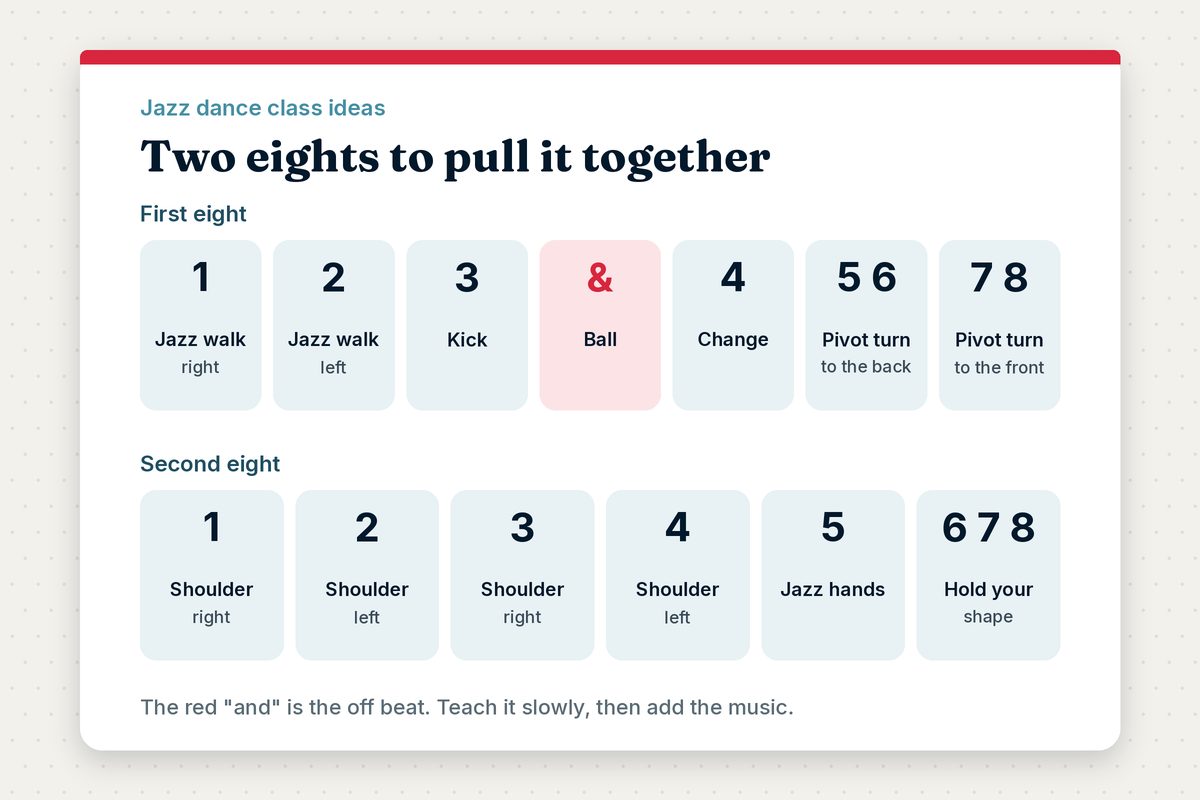
Two eights to pull it together
Here’s a simple combination for juniors that uses the ideas above. Teach it slowly, then add the music:
- Counts 1 and 2: two jazz walks forward, right then left.
- Counts 3 and 4: kick ball change.
- Counts 5 to 8: two pivot turns, to face the back and then the front.
- Next 1 to 4: shoulder pops, right, left, right, left.
- Next 5 to 8: jazz hands on 5, then hold a strong finishing shape.
Once it’s secure, ask dancers to change the character, the level or the direction. Suddenly you have a whole routine.
Graded jazz with UKAdance
Ready for first jazz exams? The UKAdance Jazz Preparatory and Primary course on Teach.Dance covers the full syllabuses for both grades. It has syllabus videos with music, full run throughs, music and scripts, and complete PDF syllabuses.
You can use it in your browser or the free Teach.Dance app on Android and Apple devices. It also includes access to the UKAdance Theatre Community group. For older dancers, UKAdance Modern Jazz Grades 4 and 5 brings both grades together in the same way.
Keep it fun
The best jazz classes feel sharp, musical and full of personality. Start small with isolations, build kicks and turns with care, and let your dancers play with the music. Do that, and you’ll have a room full of performers who can’t wait to show you what they’ve got.
Teach.Dance · For Teachers, By Teachers








Responses