
Twelve pairs of brand new tap shoes, twelve excited dancers and a noise level that could wake the whole street. If you’ve taught a first tap class, you’ll know the feeling. These tap class ideas are the ones we come back to for beginners, whether they’re five or fifty. They help turn that happy racket into clear, confident sounds.
Start with listening, not steps
Tap is a dance you hear as much as see. The quickest way to help beginners is to make listening part of every class from the very first week. Before you teach a single step, ask dancers to stand still and copy a rhythm you clap. Then copy it with their feet, just stamping. It sounds simple, but it sets up the whole lesson: we listen, then we make the sound.
A good rule for beginners is “clean before fast”. One clear sound is worth more than four muddled ones.
A simple shape for a beginner tap class
For a 45-minute class, this structure works well:
- Warm up (5 minutes). March, bounce through the knees, roll the ankles and tap the toes. Keep knees soft, as stiff legs make for heavy, tired tapping.
- Sound check (5 minutes). Copy rhythms with claps, then feet.
- Technique (15 minutes). One or two new steps, practised slowly, then to music.
- Rhythm game (10 minutes). Something playful that uses the new steps.
- Little routine (8 minutes). Eight or sixteen counts that link everything together.
- Cool down (2 minutes). Gentle stretches and a quiet, still finish.
First steps to teach
Most beginners can manage these in their first few weeks. Teach them standing at a barre or with a hand on a chair for balance if needed.
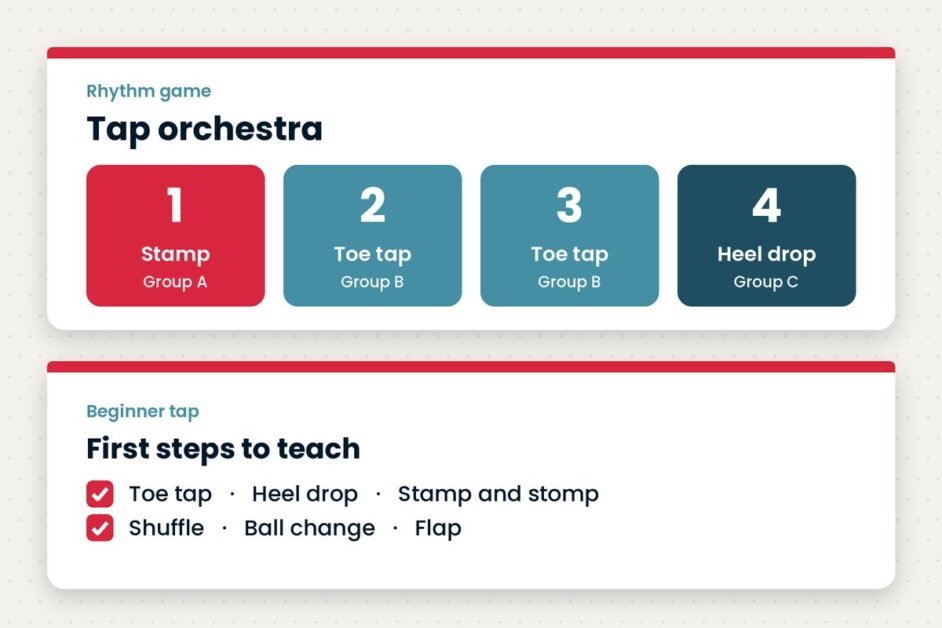
- Toe tap. Tap the ball of the foot on the floor without putting weight on it.
- Heel drop. Lift the heel and drop it down to make a clear sound.
- Stamp and stomp. A stamp takes the weight, a stomp doesn’t. Children love the difference.
- Shuffle. Brush the ball of the foot forward and back, making two sounds. Keep the ankle loose and relaxed.
- Ball change. A quick shift of weight from the ball of one foot to the other.
- Flap. A brush forward that lands with weight. Think of it as a shuffle that travels.
Name each sound out loud as you teach it. “Brush, brush” for a shuffle or “step, step” for a ball change helps dancers hear the rhythm in their heads before their feet catch up.
Rhythm games beginners love
Copy me
You tap four counts, they tap them back. Start with stamps, then add toe taps and heel drops. Once they’re confident, let a dancer lead. It’s brilliant for listening and for shy dancers who’d rather not talk.
Name rhythms
Each dancer taps the rhythm of their own name. “Ol-iv-er” is three sounds, “Grace” is one. The group copies. It’s a lovely icebreaker for a new class and gets everyone thinking in rhythms rather than steps.
Tap orchestra
Split the class into groups. One group stamps on count one, another does toe taps on two and three, and the last group does heel drops on four. Put them together and you’ve got a groove. Swap the parts round so everyone tries each one.
Freeze tap
Dancers shuffle or tap freely while the music plays. When it stops, they freeze, completely silent. Anyone who makes a sound helps you choose the next step. It’s a fun way to practise control, which matters as much as noise in tap.
Fast and slow
Call “slow”, “normal” or “double” and dancers change the speed of the same step. It builds control and shows them how one step can sound very different.
Practical bits that make a difference
Floors matter in tap. Check your venue is happy for tap shoes on its floor and that the surface is safe, not slippery or uneven. Our dance class venue checklist has the questions to ask before you book.
Music matters too. Choose tracks with a clear, steady beat for beginners, and keep a few slower versions to hand. Make sure your music licence covers the music you play in class.
Finally, think about volume. Tap is loud, and a church hall with a toddler group next door may not be the right fit. A quick chat with your venue before you start saves a lot of awkwardness later.
Teaching adult beginners
Adult tap classes are often some of the happiest in the timetable. Adults pick up rhythms quickly but can feel self-conscious, so the same games work with a lighter touch. Explain why a step works, not just how. Give a little more time for balance and ankle warm ups, and let them practise new steps in small groups rather than one at a time. Many adults come back to tap after years away, so ask what they remember and build on it.
Moving towards graded work
Once your beginners can shuffle, ball change and flap in time, many will be ready to start working towards their first grade. The UKAdance Tap Preparatory and Primary course on Teach.Dance takes you through the full UKAdance Preparatory and Primary tap syllabuses. You get syllabus videos with music, full run-throughs, built-in music and scripts, and the full PDF syllabuses. You can play the music from your laptop or the Teach.Dance app in the studio.
UKAdance was the first dance association to join Teach.Dance, and you can read more in our post on UKAdance joining Teach.Dance. For membership and exam information, visit the UKAdance website.
When exam day comes round, our guide to helping dancers with exam nerves has simple ways to keep everyone calm and smiling.
Keep it fun
Beginners stay when they feel they’re getting better. Celebrate the small wins, like the first clean shuffle or the first time the whole class finishes together. Film a short routine at the end of half term (with consent) so dancers can see how far they’ve come. Keep the classes clear, playful and full of listening, and the sound will tidy itself up week by week.
Teach.Dance · For Teachers, By Teachers






Responses