
Saturday, 9am. Eight three year olds sit in a wobbly circle. One has brought a teddy, one is still holding Mum’s hand at the door and one has already tried a forward roll. Teaching ballet for under 5s is one of the most joyful parts of the week, as long as you walk in with a plan that’s built for tiny attention spans.
Here’s a simple 30-minute class plan we use and adapt, plus the practical bits that make a pre-school class run smoothly.
Why little ones love a ballet class
Movement matters hugely at this age. The NHS physical activity guidelines for under 5s say pre-schoolers aged 3 to 4 should spend at least 180 minutes a day doing a variety of physical activities, including at least 60 minutes of moderate to vigorous activity. Dancing is right there on the NHS list of activity ideas.
A weekly ballet class won’t cover all of that, of course. But it gives children a happy, structured half hour of moving, listening, taking turns and using their imagination. It’s also a gentle first step into a class routine, which helps build confidence.
Before you start
A few practical decisions make everything easier:
- Keep it short. Thirty minutes suits most 2 to 4 year olds. Rising fives can often manage 45.
- Have a helper. An assistant can take a dancer to the toilet or comfort a tearful one while you keep the class going.
- Use a clear space. Mark a circle or spots on the floor with tape or small mats so everyone knows where home is.
- Plan your music. Short tracks with a clear beat and plenty of changes in mood work best.
Safeguarding still matters at this age, perhaps more than ever. The DfE’s safeguarding guidance for out-of-school settings says that where children aged 5 and under attend, they should be adequately supervised. They should usually be within both sight and hearing of staff, and always within sight or hearing. The same guidance says you should have at least one person with a current paediatric first aid certificate where children aged 5 and under attend.
That’s another reason a helper is so valuable. Our guide to dance school assistants covers how to find and train one.
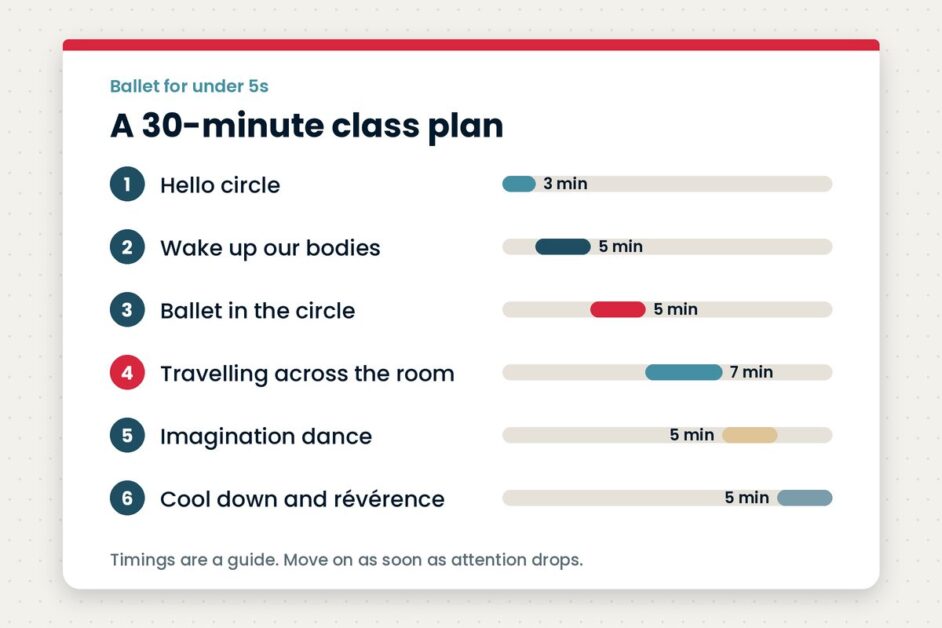
A 30-minute class plan
Timings are a guide. Watch the room and move on as soon as attention drops.
1. Hello circle (3 minutes)
Sit in a circle and sing a hello song with each child’s name. It doubles as your register. Ask a simple question, like “Who can show me a happy face?” Little ones settle far better when they hear their own name.
2. Wake up our bodies (5 minutes)
Seated warm up with a story. Wake up the fingers, then the shoulders, then the toes. “Sleepy feet” are flexed, “pointy feet” are stretched. This is where you quietly introduce pointing the foot, one of the first real ballet skills. Keep legs straight but soft, and never push or pull a child into position.
3. Ballet in the circle (5 minutes)
Stand up in your spots. Try small pliés with a story: “bend down to smell the flowers, stretch up tall like a tree”. Rise up on the balls of the feet to peep over the garden wall. Use natural turnout only. At this age you’re teaching posture, balance and listening, not positions.
4. Travelling across the room (7 minutes)
This is the bit they’ve been waiting for. Marching soldiers, tiptoe mice, galloping ponies and skipping, if they’re ready. Send them in twos or threes so they have space and you can watch everyone. Add a simple “freeze” game: when the music stops, hold your best statue.
5. Imagination dance (5 minutes)
Bring out scarves, ribbons or a parachute. Tell a short story, such as leaves falling in autumn or snowflakes in December, and let them interpret it. Keep one or two simple ballet ideas in it: pointed feet, soft arms, a gentle run on tiptoes.
6. Cool down and révérence (5 minutes)
Lie down and be sleeping stars, then sit up for a quiet stretch. Finish with a révérence, the ballet bow or curtsy, to say thank you. Stickers or a stamp on the way out make the goodbye quick and happy.
Teaching tips that really help
- Show, don’t tell. Little ones copy what they see far more than what they hear.
- Use one instruction at a time. “Find your spot” works better than a three-part sentence.
- Use the same structure every week so they know what comes next.
- Praise effort out loud and by name. “Lovely pointy feet, Ava!”
- Have a calm plan for tears. A quiet seat near your helper is usually enough.
Props are a brilliant way to keep things fresh. Our interview on keeping ballet classes engaging shares ideas on props and colouring sheets that work well for little ones.
Talking to parents
Parents of under 5s often want to watch. Many schools offer a watching week each term instead, so dancers can focus. If parents do watch or film, agree clear rules on photos and sharing. Our guide to data protection for dance schools covers consent for photos and video.
When they’re ready for more
Once your little dancers can listen, take turns and point their feet, many will be ready for a syllabus. The UKAdance Ballet Preparatory and Primary course on Teach.Dance takes you through the full UKAdance Preparatory and Primary ballet syllabuses. You get step-by-step syllabus videos with music, full run-throughs, scripts and teaching notes, and the full PDF syllabuses. You can use it in your browser or on the free Teach.Dance app. The official Guy Dearden music needed for exams is bought separately.
UKAdance was the first dance association to join Teach.Dance. You can read more in our post on UKAdance joining Teach.Dance, or visit the UKAdance website.
If you teach the very youngest, from babies up to age 4, take a look at our Mini Movers early years dance programme. Our guide to Mini Movers explains how a ready-made early years programme can sit alongside your ballet classes.
Quick answers
How long should a ballet class for under 5s be?
Thirty minutes is a good starting point for 2 to 4 year olds. Many schools move to 45 minutes once children are nearly 5 or starting school.
Should I teach ballet positions to 3 year olds?
Keep it light. Pointed feet, soft arms, good posture and listening to music are plenty. Use natural turnout and never force a position.
Teach.Dance · For Teachers, By Teachers







Responses