
Show week. The costumes are steamed, the running order is taped to every wall backstage and a parent has just arrived with a car boot full of donated prizes for the interval. A dance school raffle is a lovely part of a Christmas show. Families enjoy it, it raises money for a good cause and the little ones love watching the draw.
It’s also a lottery in the eyes of the law, so there are a few rules to follow. Getting them right is easy once you know them, and it means nobody has an awkward conversation in January.
Why raffles have rules
In Great Britain, raffles, tombolas and sweepstakes all count as lotteries. The Gambling Commission explains the types of lottery you can run without a licence, and says you must follow the rules for the type you plan to run. If you don’t, you could break the law and face a fine or even imprisonment. That sounds dramatic, but in practice the rules for a show raffle are short and sensible.
Helpfully, the Commission’s own example of this type of lottery is a community theatre group holding a tombola in the interval of its Christmas panto. That’s very close to what most of us do in December.
The rules for a raffle at your show
A raffle or tombola at your show is usually what the Commission calls an incidental lottery. Its guide on how to run a fundraiser with lotteries or raffles at events sets out the main points:
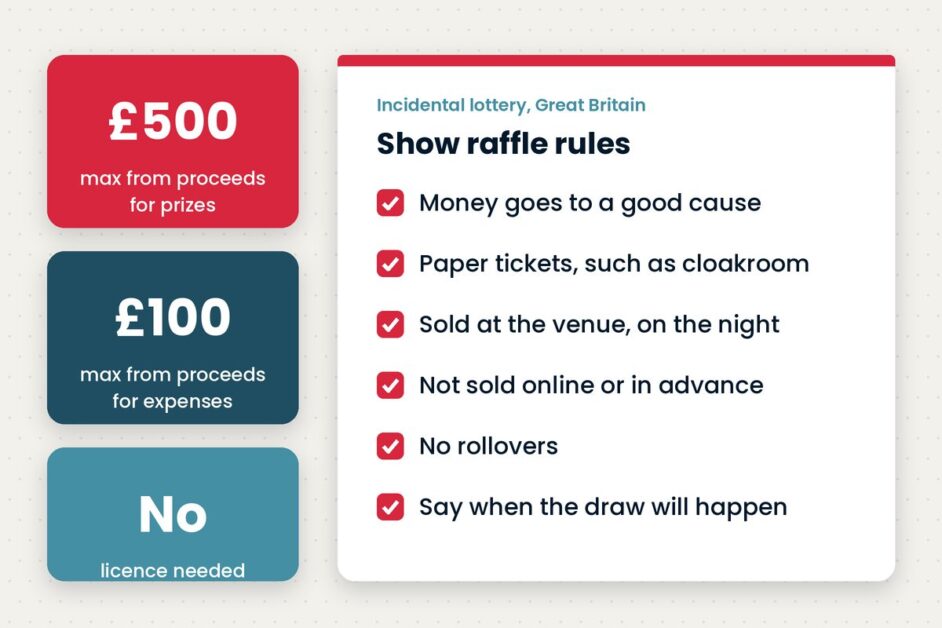
- You don’t need a licence.
- The money raised must go to charity or other good causes. It can’t be run for private or commercial gain.
- The raffle can’t be the main reason for the event. It has to sit alongside it, like a tombola in the interval of your show.
- You must use physical tickets. Cloakroom tickets are fine.
- Tickets can only be sold at the venue while the event is taking place. That means no selling online, on social media or in advance.
- You can set any ticket price, and you can offer deals such as five tickets for £2.
- Children can buy tickets.
- You can use up to £100 of the money raised to cover your expenses, such as buying the tickets.
- You can use up to £500 of the money raised to buy prizes. There’s no limit on the value of donated prizes.
- There are no rollovers. Every prize has to be won on the day.
- The draw can happen during or after the event, as long as you make it clear when the result will be announced.
The big one: where does the money go?
This is the point that catches dance schools out. Most of us run our schools as private businesses, and an incidental lottery can’t be used for private or commercial gain. So a raffle to top up your school’s takings, or to pay for your new sprung floor, isn’t the right fit.
A raffle for a charity is perfect. Plenty of schools choose a local children’s hospice, a hospital ward, a food bank or a charity that matters to one of their families. Tell your audience who you’re raising money for and why. Families like to know where their money is going, and your dancers learn something lovely about giving back.
If you’re not sure whether your cause counts, ask the Gambling Commission before the show. Its contact line is 0808 8020 133 in England and Scotland and 0808 2819 265 in Wales.
What if you want to sell tickets in advance?
Lots of schools want to sell raffle tickets in the weeks before the show. That isn’t allowed for an incidental lottery. Advance and online sales belong to other types of lottery with their own rules.
One is a small society lottery. The Commission says these can raise money for good causes, but not for commercial purposes, and must be registered with your local licensing authority. It gives charities, sport and community groups as examples. If your school has a linked charity or a parents’ fundraising group, that might be a route to explore. Because these lotteries can’t be for commercial purposes, check with your council’s licensing team before you start.
What about a prize draw just for your families?
The Commission also describes a customer lottery, which a business can run for customers on its premises. The rules are tight. All the money from ticket sales must go on prizes and expenses, so you can’t make a profit. Each prize must also be under £50 in value. The Commission is clear that customer lotteries cannot be used for fundraising. For most show raffles, the incidental lottery rules are the ones you need.
A simple raffle checklist for show week
- Choose your charity or good cause and tell families early.
- Buy a book of cloakroom tickets. Keep the cost under £100.
- Gather donated prizes, and keep any bought prizes within £500 in total.
- Plan a ticket table near the entrance, staffed by two adults, with a cash box and card reader if you use one.
- Sell tickets only on the night, at the venue.
- Decide when you’ll draw. The interval or the finale both work well.
- Announce clearly how winners will be told if they’ve already gone home.
- Keep a simple note of what you raised and what went to the charity, then share the total with families.
Make your show run smoothly
A raffle is only one part of show planning. If you’re performing in a theatre with children in the cast, our guide to dance school shows and BOPA covers chaperones and licensing. It’s also worth checking your music licence covers public performances, not just weekly classes.
Finally, think about photos. Audiences love snapping the raffle draw, especially when a dancer pulls out the winning ticket. Our guide to data protection for dance schools covers photo consent and what to say to families before the show.
This is general guidance, not legal advice. The rules above apply in Great Britain, so check local guidance if you teach in Northern Ireland, and contact the Gambling Commission or your local licensing authority if you’re unsure.
Teach.Dance · For Teachers, By Teachers









Responses