
It’s 6.15pm on a Tuesday in November. Your juniors’ class has just finished, it’s pitch black outside and the car park is busy with headlights. One mum is stuck in traffic. Two dancers are already halfway out of the door. This is the moment a clear dance school drop-off and collection routine earns its keep.
The clocks go back at 2am on Sunday 25 October, so most of your after school classes will soon start or finish in the dark. It’s a good week to look at your routine with fresh eyes, before the darker evenings arrive. None of this needs to be complicated. It just needs to be the same every week, so dancers, parents and your team all know what happens.
Start with the register
The Department for Education’s safeguarding guidance for out-of-school settings is written for clubs, tuition and activities like ours. It says you should have a register of children attending and take a register at the start of each session. It also points out that a register helps in an emergency, such as a fire or a child going missing.
In a busy studio, the register is also your collection checklist. Tick dancers in as they arrive and tick them out as they leave. If you use an app, that’s fine. A paper register on a clipboard works just as well, and it doesn’t run out of battery during a fire drill.
Know who is allowed to collect
The same guidance suggests you collect key details when a child enrols. That includes more than one emergency contact number, the parent’s full name and the child’s home address where reasonably possible, plus any health conditions or medical needs. It also suggests asking families to update their contact details, perhaps once a year.
We’d add one more question to your enrolment form: who is allowed to collect this child? Ask for names and how they’re related, whether that’s Grandad on Tuesdays or a neighbour on Thursdays. If someone new turns up, a quick call to the parent sorts it out kindly. Most families are glad you checked.
Keep these details somewhere secure and only share them with staff who need them. Our guide to data protection for dance schools covers how to store contact and medical information properly.
Make the handover visible
The simplest collection routines have one thing in common. Every dancer is handed over to a grown-up you can see. Here’s a routine that works in most halls and studios:
- One adult stands at the door at the end of class with the register.
- Dancers wait inside, changing shoes or packing bags, until they spot their grown-up.
- Each dancer says goodbye to you at the door, so you see who they leave with.
- Nobody waits outside alone in the car park, even for a minute.
- Older dancers who walk or get the bus home do so with written agreement from a parent.
If you hire a church hall or community centre, check the outside lighting and the route from the door to the car park now, while it’s still light at 6pm. Our dance class venue checklist has more on what to ask your venue.
When a parent is running late
It happens to every school, usually on the wettest night of the year. Decide your plan in advance so nobody has to make it up on the spot. The DfE guidance is clear that visiting parents and carers are not exempt from your child protection procedures. It also says you should never leave a child unsupervised with another parent or carer. So the kind offer from another mum to wait with them isn’t the answer.
A plan many schools use looks like this. You or your assistant stays with the child inside, ideally with two adults present. You ring the parent, then the emergency contacts in order. You note what happened and what time the child was collected. Keep the tone warm. The child hasn’t done anything wrong, and the parent is probably flustered enough already.
If late collection becomes a pattern for one family, have a friendly private chat. Put your late collection plan in your terms and conditions so it’s fair and the same for everyone.
If a dancer goes missing
Nobody likes to think about it, but a short written plan means you’ll act quickly and calmly. The DfE guidance sets out a clear order. Alert your designated safeguarding lead or a senior staff member and search inside and outside the building. Then contact the child’s parents or carer to check whether they’ve gone home. It also says that if the missing child is 5 years old or under, you should contact the police immediately.
If you’re looking after several children, the guidance says you should not leave the others unattended to search. This is where a second adult makes all the difference, and it’s one more reason to value good dance school assistants.
Tell families the plan
A routine only works if families know about it. Put it in your welcome email, mention it at the start of term and pin it in your parents’ group. Keep it short and friendly, something like this:
“From 26 October it’ll be dark at collection. Please come to the door for your dancer and we’ll hand them over to you. If you’re running late, call us and we’ll wait inside together. If someone else is collecting, just let us know beforehand.”
New families need it most. If you’re running trial classes this half term, add your arrival and collection times to the welcome message. Our guide to trial classes for new families has a template you can adapt.
Make sure your whole team knows it
Your assistants, cover teachers and helpers all need to know the routine, including what to do if a parent is late or a stranger turns up. Run through it at your next team catch-up. It takes ten minutes and it’s far easier than explaining it on a dark night.
For a refresher on the bigger picture, try Introduction to Safeguarding in Dance (Level 1). It’s a BDSA course, powered by Teach.Dance, and it’s free for every Teach.Dance member. It takes about 35 to 45 minutes and ends with a certificate, so it’s an easy way to get the whole team on the same page. Our post on free safeguarding training for dance teachers explains who the course is for and how it works.
Your quick collection checklist
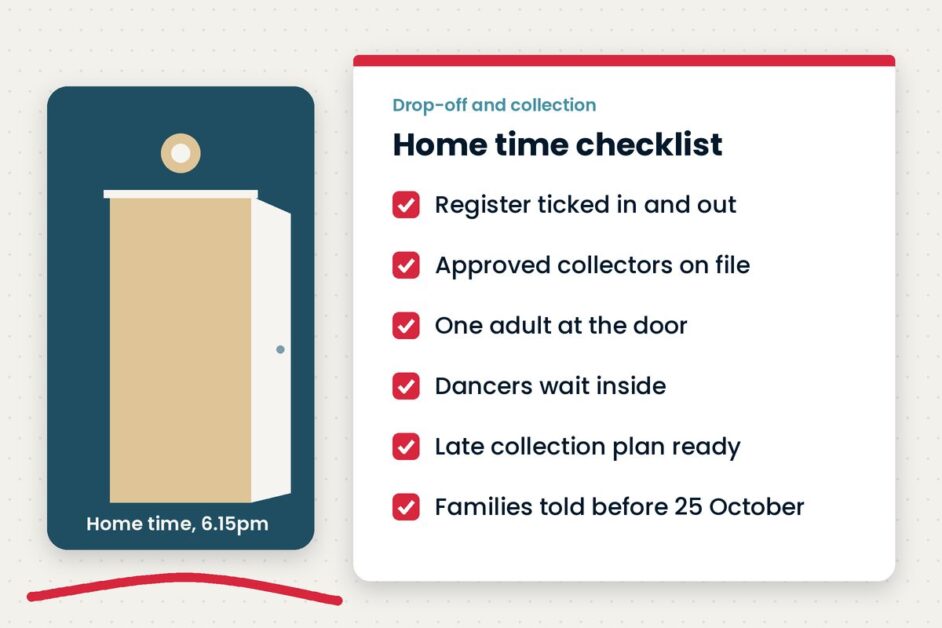
- Register taken at the start of every class and dancers ticked out at the end.
- Emergency contacts and approved collectors on file and up to date.
- One adult at the door at home time, with dancers waiting inside.
- A written plan for late collection and for a missing child.
- Outside lighting and the route to the car park checked with your venue.
- Families told about the routine before 25 October.
This is general guidance, not legal advice. Check the full DfE guidance and your own safeguarding policy, and speak to your designated safeguarding lead if you’re unsure.
Teach.Dance · For Teachers, By Teachers







Responses