
Put a hip hop track on at the start of class and watch the room change. Heads nod, shoulders loosen and suddenly everyone wants to move. These hip hop dance class ideas help you turn that energy into real foundations, so your dancers learn the style properly rather than just copying moves from their phones.
They’re aimed at beginners of any age, from juniors to adult classes. Pick one idea from each section and you have a full class.
Where hip hop dance comes from
A little history goes a long way in a hip hop class. NPR’s story on 50 years of hip hop goes back to August 1973, when an 18 year old DJ Kool Herc played his sister’s back to school party in the Bronx. He noticed that dancers went wild in the short drum breaks of funk and soul records, so he found a way to make those breaks last longer.
The dancers who took over in those breaks became B-Boys and B-Girls, and their dance became breaking. NBC Olympics’ guide to breaking’s Olympic debut explains that breaking began as toprock, danced standing up. Five decades later, it made its Olympic debut at the 2024 Paris Games.
Popping has its own story. Fresno State News describes how popping started in Fresno, California, and reached a national audience when the Electric Boogaloos appeared on Soul Train in 1979. Historians still discuss its exact origins, which is a nice point to share with older students.
So hip hop dance isn’t one style. It’s a family of styles with their own roots. House is another of the foundation styles, and we looked at it in detail in our spotlight on teaching House dance. This post sticks to grooves, toprock, popping and cyphers.
Start with the groove
Everything in hip hop sits on the groove. Before any steps, get dancers moving to the beat in a way that feels natural.
The bounce
Ask dancers to bend their knees softly on every beat, letting the chest and head follow. Then try it the other way, lifting up on the beat instead. Swap between the two every eight counts so they really feel the difference.
The rock
Now lean the chest forward and back with the music, keeping the knees soft. Add a simple step touch underneath. Dancers often stiffen up here, so remind them it should feel relaxed, like nodding along at a gig.
Groove mirror
Put dancers in pairs facing each other. One leads a groove for eight counts and the other copies, then they swap. It takes the pressure off, because nobody is dancing alone.
If you want more on groove and texture, our post on rethinking execution in street dance is worth a read. Our guide to common street dance mistakes also covers stiff grooves and how to fix them.
Toprock: breaking from standing
Toprock is the upright part of breaking, danced before a breaker goes down to the floor. It’s ideal for beginners because it builds rhythm, attitude and footwork without any risk from floor moves.
Cross step
Cross one foot over the other on the beat, step back to open, then repeat on the other side. Keep the arms loose and let the chest lead. Once it feels steady, add a small hop or a turn of the shoulders.
Kick step
Kick one foot forward lightly, step it back down, then switch sides. Ask dancers to keep the kicks low and controlled, and to stay on the beat rather than kick high.
A word on floor work
Footwork on the floor, such as a simple six step, can come later with confident and older groups. Warm the wrists and shoulders well first, and leave power moves, head spins and freezes on the head out of a general class. A clean, suitable floor matters too, and One Dance UK’s industry standards are a useful guide to healthy dance practice.
Popping basics: the hit
Popping is all about the hit, a quick tense and release of the muscles on the beat. Start with the forearms. Ask dancers to tense them sharply on the beat, then relax straight away.
Next, try the chest and the legs, one at a time. Then put two together. A simple drill is to hit on every snare and stay smooth in between. It teaches control and musicality in one go.
The fresno is a classic popping step and a great one for beginners. Step out to the side, hit, step back in, hit, then repeat to the other side. Keep it small and sharp at first.
Cyphers and battles, made friendly
A cypher is a circle where dancers take turns in the middle. It’s at the heart of hip hop culture, and it’s a brilliant way to build confidence when it’s set up kindly.
- Everyone in the circle grooves and claps along, so nobody stands still watching.
- Dancers choose when to go in, and nobody is pushed into the middle.
- Keep turns short at first, around eight counts.
- Cheer every turn, whatever the level.
- Finish a friendly battle with a handshake or a hug, if both dancers are happy to.
If your dancers freeze up when it’s their turn, our post on how to get dancers to freestyle has practical drills to help.
Choose the music carefully
Lots of hip hop tracks have explicit lyrics, so always use clean edits for children’s classes. Listen to the whole track before class, not just the first minute, because some edits still let words slip through.
Check your music licence for dance classes covers what you play. If you’re putting together a mix, our music mixing tips for dance teachers will help.
A cypher can feel exposing for some dancers, so keep an eye on confidence and on how dancers talk to each other. The free Safeguarding in Dance Level 1 course is a BDSA course powered by Teach.Dance, with BDSA as our endorsing and co-branding partner, and it’s a good refresher for any teacher.
A simple 45 minute hip hop class
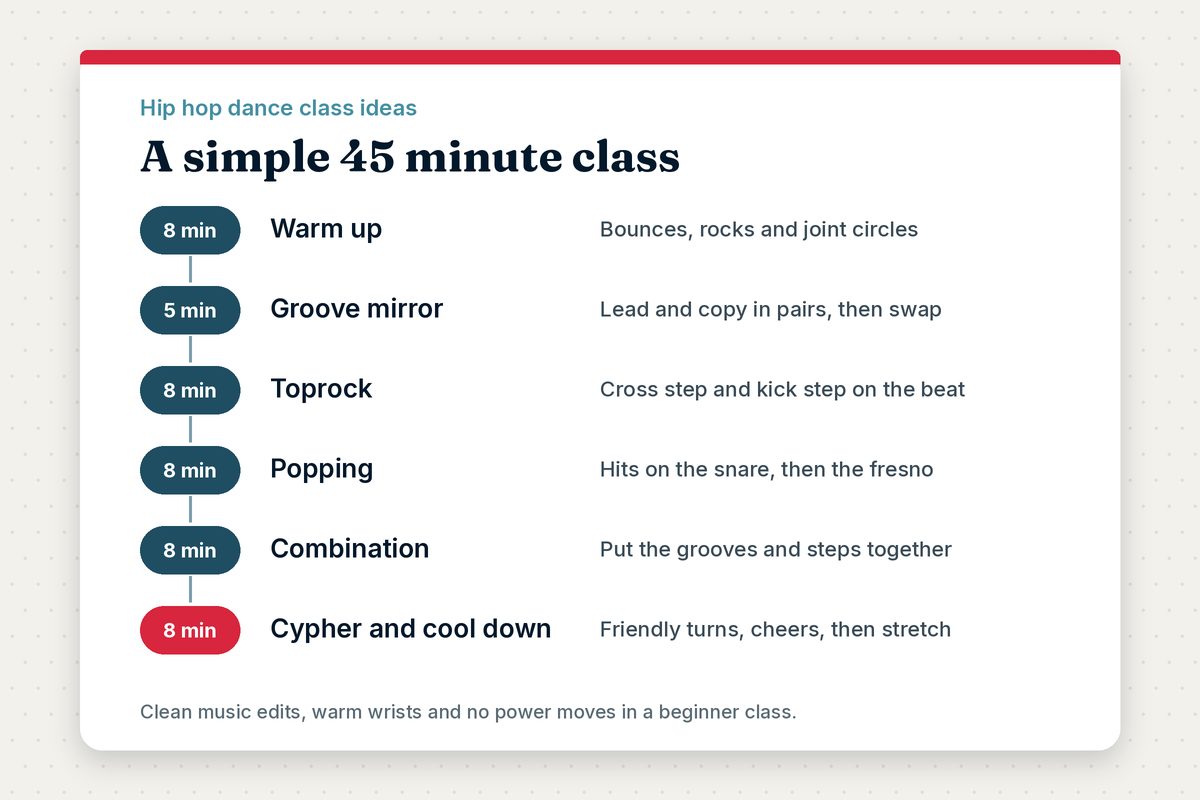
- Warm up with bounces, rocks and joint circles, about 8 minutes.
- Groove mirror in pairs, about 5 minutes.
- Toprock cross step and kick step, about 8 minutes.
- Popping hits and the fresno, about 8 minutes.
- A short combination using everything so far, about 8 minutes.
- A friendly cypher, then a cool down and stretch, about 8 minutes.
Take it further
If you’d like to grow your street dance teaching, the Street Dance House Foundations mini course takes you from the first groove to confident freestyle. It pairs nicely with these hip hop ideas, because so much of the bounce and footwork carries across.
Our post on the Street Dance Training partnership explains where our street courses come from. For a full lesson framework, see how to structure a commercial dance class.
Keep it real
The best hip hop classes feel like a party with purpose. Start with the groove, give dancers a little of the history, and let the cypher do the rest. You’ll see confidence grow week by week.
Teach.Dance · For Teachers, By Teachers







Responses