
Dance school data protection: photos, videos and consent

Think about the last time your little ones took their bow in a sparkly costume. Within minutes, the phones were out. Photos and videos are a joyful part of studio life. They celebrate progress, give families memories to keep and show the world what your classes are about.
Handling images and personal information well is part of keeping children safe, and it builds parents’ trust in your school. Below, we look at dance school data protection: what the law means for you, how to ask for consent and how to share photos safely. This is general guidance, not legal advice.
When data protection law applies
Here’s the simple version. When a parent posts show photos to a private account seen only by friends and family, the ICO says that’s likely to be personal use. Data protection law doesn’t apply to purely personal or household activity. Posting to a public account, seen by an indefinite number of people, is likely to go beyond personal use.
The ICO (Information Commissioner’s Office) is the UK’s data protection regulator. Its guidance on taking photos in schools is written for schools, but it translates well to a dance studio.
Photos and videos you take for your school are different. If you use them for promotional material, such as your website or a flyer, data protection law is likely to apply. The ICO says pupils or their parents, depending on the pupil’s age, must be told how the images will be used. You’ll also need a valid reason, known as a lawful basis, to publish them.
The Data (Use and Access) Act 2025 updated parts of data protection law. The ICO’s overview of what the Act means for organisations confirms its data protection changes are now in force. The ICO’s photos guidance is still marked as under review, so check the live page when you update your consent forms each year.
Children’s information needs extra care
The ICO’s guidance on children and the UK GDPR treats anyone under 18 as a child. It explains that children merit specific protection, because they may be less aware of the risks. You must use their information fairly and within their reasonable expectations. You must also explain what you do with it in clear, plain language.
Consent is one lawful basis, but not the only one. The ICO says another basis can sometimes be more appropriate, and can even offer stronger protection for the child. Whichever basis you use, the ICO’s schools guidance recommends giving pupils the chance to opt out of their image being used.
The Act also created a new lawful basis, which the ICO calls recognised legitimate interest. Put simply, it covers a short list of pre-approved purposes, and one of them is safeguarding: protecting children and at risk adults from harm. It won’t cover your marketing photos. It can help if you ever need to share information to protect a child, as long as sharing is necessary.
When can a child agree for themselves?
There’s no single age that applies everywhere. The ICO’s guidance on lawful bases for children’s information explains that in England, Wales and Northern Ireland, it depends on the child’s level of understanding. In Scotland, children are presumed to have capacity from the age of 12. The ICO says that in many cases it’s reasonable to follow the Scottish approach.
Asking for consent the friendly way
Children should always be consulted about the use of their photo or video. That’s the starting point in the NSPCC’s guidance on photographing and filming children. For under 16s, it advises getting parental consent too. For 16 and 17 year olds, such as your senior students or young assistants, you can decide whether parental consent is appropriate.
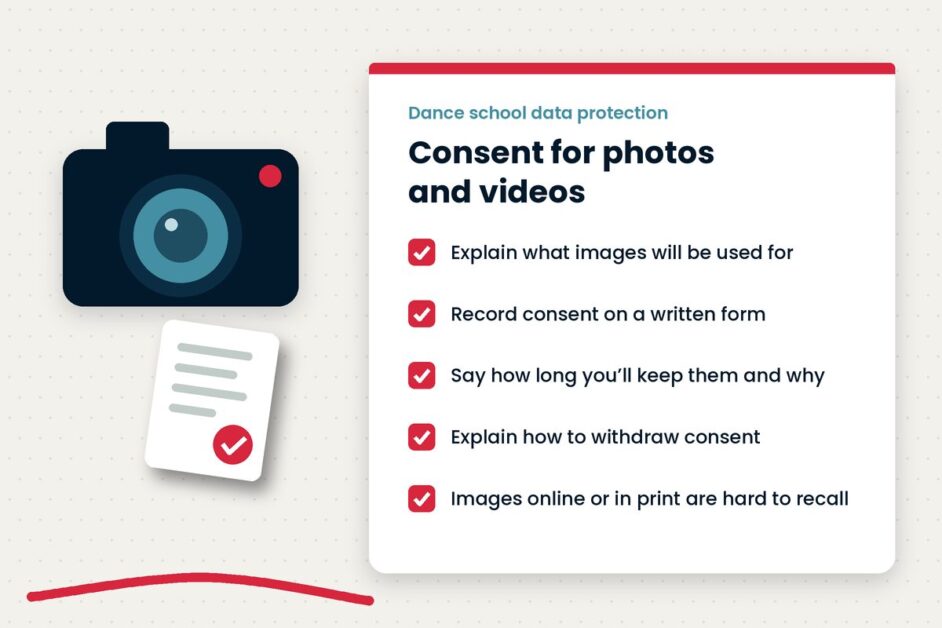
Good consent means everyone knows what they’re agreeing to. Following the NSPCC’s advice, you’d:
- explain what the photo or video will be used for
- ask for consent and record it on a written form
- say how long you’ll keep the image and why
- explain how to withdraw consent, and what you’ll do then
- be clear that once an image is online or in print, it’s very hard to recall.
The NSPCC suggests sharing your photography and filming policy statement with families at the start of the year. You might need extra consent in some cases. Examples include a professional photographer booked for your show, or local press wanting to cover your school.
When a family says no
Families can have good reasons for saying no. The NSPCC mentions religious or cultural reasons, a child who is in care or adopted, or a family who has experienced abuse. Respect their wishes, and never leave a child out of an activity because you don’t have consent. The NSPCC suggests a simple sticker or badge, so whoever is taking photos knows who not to include.
Picture your Christmas show: the professional photographer is booked, and two families have said no to photos. Those two dancers still take their bow with everyone else. A sticker or badge tells the photographer who to leave out.
Sharing photos safely online
Before you post, ask whether the image shows the dancing or the child. The NSPCC’s guidance includes some easy habits:
- focus on the activity rather than the child
- use shots from a distance, or side on for close-ups
- choose images of children in appropriate clothing
- don’t add children’s names to images
- remove location data and other metadata before uploading.
In dance, costumes and practice wear deserve a second look before anything goes online. The NSPCC also advises using your organisation’s own devices rather than personal phones, and storing images securely. Our social media tips for dance teachers have more ideas for showing off your school.
Parents filming at shows and competitions
Parents love filming their children, and the ICO is clear that personal use falls outside data protection law. The NSPCC still recommends a policy statement that sets your expectations before the event. That includes asking parents to get permission before sharing photos of other people’s children on social media. A friendly reminder in your show letter, alongside the BOPA and show licensing guide, sets a positive tone. Our guide to music licences for dance classes covers the music side of your show.
Medical forms and health information
Most of us ask about asthma, allergies, injuries or additional needs on enrolment forms. The ICO’s page on special category data explains that health data is one of these categories. It covers information on injury, disease or disability, including medical history. Special category data needs extra care. The ICO explains that you need a valid condition under the law to use it.
In practice, only ask for what you need to keep each dancer safe in class. Keep forms secure, share them only with the teachers and assistants who need them, and update them each year.
The data protection fee
Many organisations that handle personal information pay a yearly data protection fee to the ICO. Not everyone has to, as many can rely on an exemption. The ICO’s guide to the data protection fee sets out three tiers. Micro organisations, with a maximum turnover of £632,000 or no more than 10 members of staff, pay £52 every 12 months. You get a £5 discount by paying by Direct Debit. The ICO has a short online self-assessment to check whether you need to pay.
Handling data protection complaints
Here’s a simple one to set up. The Act brought in a new requirement for every organisation, with no exemptions. The ICO’s guidance on data protection complaints says you must give people a way to complain to you. You must acknowledge a complaint within 30 days. You must then respond and tell them the outcome without undue delay. The ICO gives an electronic complaints form as one example, so a simple form on your website is an easy option.
If something goes wrong
Mistakes happen, like a register emailed to the wrong parent or a lost phone full of class videos. The ICO’s guidance on personal data breach reporting has a self-assessment tool to help you decide whether to report it. Where a breach needs reporting, you must tell the ICO as soon as possible, and where feasible within 72 hours. Acting quickly and openly protects the families involved.
Quick FAQ
Do I need consent to post a class photo on our website?
You need a lawful basis, and consent is one option. Whatever basis you use, tell families how images will be used and give them the chance to opt out. The NSPCC recommends written consent from parents for under 16s.
Can I use my own phone to take class photos?
The NSPCC advises using devices that belong to your organisation and storing images securely.
With a clear policy, simple consent forms and a few good habits, you can keep sharing your dancers’ achievements with confidence. For the wider safeguarding picture, the Teach.Dance Introduction to Safeguarding in Dance (Level 1) course is a good next step for you and your team.
Teach.Dance · For Teachers, By Teachers




Responses