
Results day 2026: helping your dancers with next steps


She’s been in your Saturday class since she was four. Now she’s 16, results day is next week and she’s asked if she can have a word after class.
For teenage dancers, August can bring big decisions. Results can open doors, close others and change plans overnight. As their dance teacher, you’re often one of the steady adults in their week.
The Joint Council for Qualifications key dates for June 2026 list A level results on Thursday 13 August. GCSE results follow on Thursday 20 August. These dates cover England, Wales and Northern Ireland, and Scotland has its own results day. Below are a few Teach.Dance ideas for supporting your dancers on results day and afterwards.
Be there for every result
Some dancers will be thrilled, and some will be quietly disappointed. A few will be both at once. What helps most is a teacher who asks how they feel, rather than what they got.
Keep your studio a calm place that week. A familiar class and a friendly face can mean more than you realise.
Dancers thinking about vocational training
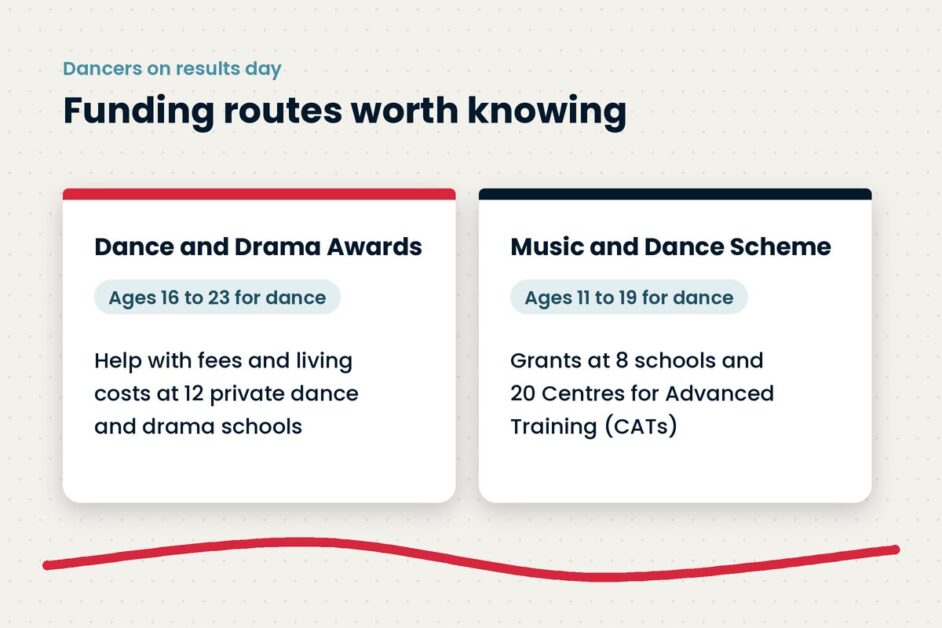
Some of your older dancers may be dreaming of full time training. It’s worth knowing about the Dance and Drama Awards, often called DaDA. They help with fees and living costs at one of 12 private dance and drama schools.
The gov.uk page says students must be aged 16 to 23 for dance courses. They apply directly to the school, and tell it they want to apply for a DaDA. The amount depends on household income and where the student lives and studies.
Students need to be studying for one of the Trinity College London diplomas listed on the page. There are residence rules too, so point families to the full details. Your role is to share the options, not to choose the route.
Younger dancers and the Music and Dance Scheme
Results season is also a good moment to think about your younger talent. The Music and Dance Scheme offers grants and help with fees at 8 schools and 20 Centres for Advanced Training, known as CATs.
For dance, children must be aged 11 to 19. Disabled students at CATs are eligible up to the age of 25. The page says CATs won’t usually accept new applications from students who’ll be 17 or over when they start.
Families apply directly to the school or CAT, and children usually audition. The school or CAT asks about household income to decide how much funding a child can get.
Keeping dance in a busy new routine
Sixth form, college, apprenticeships and university all change a dancer’s week. It’s a time when some teenagers drift away from class, simply because their week looks different.
Talk to your older dancers before September. Could they move to a later class, or a Saturday slot? A flexible option can keep them dancing through the next two years.
Some may be curious about teaching one day. Our Teach.Dance guides to becoming a dance teacher and dance teaching qualifications in the UK are a good place for them to start.
When plans change
Sometimes results mean a change of direction. Listen first, and don’t rush to fix it. Encourage the dancer to speak to their school or college careers adviser about their options.
If dance is part of the new plan, offer to talk it through with them and their family. If it isn’t, let them know they’re always welcome back in the studio.
Celebrate the dancer, not the grades
It’s tempting to share every success on social media. Grades are personal, though, so always ask the dancer and their parents before posting anything. A simple message in class celebrating effort and growth is a kind alternative.
Your next step is a short, kind message to your Year 11 and Year 13 dancers before results day. Let them know you’re thinking of them, whatever happens.
Teach.Dance · For Teachers, By Teachers








Responses