
Holiday dance camps: Ofsted, HAF and childcare explained

Half term is nearly here, and parents are already asking whether you’re running a dance camp. Holiday workshops are some of the happiest days in the studio calendar. Dancers learn a routine in a week, make new friends and perform it for their families on the last afternoon.
They can also help your school grow. Before you open bookings, here’s what to know. We’ll cover when Ofsted registration applies, how parents might pay with Tax-Free Childcare and how the Holiday Activities and Food (HAF) programme works. The Ofsted and HAF rules in this post apply to England. If you teach elsewhere in the UK, check with your own nation’s childcare regulator. This is general guidance, not legal advice.
Do dance camps need to register with Ofsted?
Most childcare providers looking after children under 8 must register with Ofsted. That’s set out in Ofsted’s guidance on registration exemptions. There are exemptions, though, and one is especially relevant to dance camps.
You don’t have to register if you provide tutoring or coaching in one or two of these activities to children aged 3 and over:
- school study support or homework support
- sports
- performing arts
- arts and crafts
- religious, cultural or language studies.
Dance sits within performing arts. A camp that offers dance plus arts and crafts covers two types, which is fine. Adding a third type, such as sports coaching as well, would take you outside this exemption.
The details that matter
Ofsted adds some important conditions. The exemption doesn’t apply if children under 5 attend for more than 4 hours in any one day, including the activity. Children aged 5 and over can attend for longer.
The activity must also be the main focus of what you offer, and any childcare must happen because of it. Ofsted says the aim must be for children to improve their skills, rather than just be entertained. A dance camp where children learn technique and choreography fits that well. Time for drop off, pick up and lunch breaks is fine.
Picture a five-day October half term camp for 5 to 11 year olds. It offers dance plus arts and crafts, with a routine learned over the week. Families come to a sharing on the last afternoon. That’s two activities, and every child is 5 or over, so the 4-hour limit for under 5s doesn’t apply.
Not sure if your camp is exempt? Read Ofsted’s guidance carefully, and look again whenever your camp changes. For example, look again if you add a third activity or take under 5s for more than 4 hours a day.
The voluntary Childcare Register
Even if you’re exempt, you can choose to register. Ofsted explains that the voluntary part of the Childcare Register is the only way to register if you’re exempt. Being on it means parents and carers can claim Tax-Free Childcare for your camp.
Ofsted’s page on joining the Childcare Register sets out what you’ll need. You need to be looking after children for more than 2 hours in a day to register. You’ll also need:
- an enhanced DBS check with barred lists
- at least one person on site with a first aid certificate
- at least one person on site with training that meets the register’s requirements
- the registration fee, which is usually £114 and paid each year.
Ofsted also recommends joining the DBS Update Service to keep your details up to date. Those requirements line up with the safe practice most of us already follow, from first aid cover to checked staff.
How Tax-Free Childcare works for parents
Being able to use Tax-Free Childcare can make a holiday camp easier for families to book. The gov.uk guide to Tax-Free Childcare explains that for every £8 a parent pays into their childcare account, the government adds £2. The top up is up to £500 every 3 months for each child, or up to £1,000 every 3 months if the child is disabled.
Parents usually need to be working, and their child must be 11 or younger, or 16 or younger if disabled. Gov.uk lists holiday clubs as something families can use it for. The provider must be an approved, registered provider, and must be signed up to the scheme.
Signing up as a provider
Once you’re registered, the gov.uk page on signing up to Tax-Free Childcare as a provider explains the next step. You’ll need the 11 digit user ID from your registration letter, your bank details and the business postcode registered with Ofsted. Gov.uk notes that parents can’t use both childcare vouchers and Tax-Free Childcare to pay for the same childcare.
The Holiday Activities and Food programme
The HAF programme is another way to reach more children. Put simply, HAF pays for free holiday provision for eligible children. The Department for Education’s HAF programme guidance explains that it gives grant funding to local authorities, who coordinate the provision. Ofsted describes it as mainly for school-aged children from Reception to the end of Year 11 who get free school meals.
The DfE’s guidance for 2026 to 2027 says Easter, summer and Christmas remain the core delivery periods, with some flexibility for half terms. Local authorities are encouraged to take a flexible approach and hold an open call for applications. That can include smaller community organisations. Many local authorities fund providers across several holiday periods.
What HAF providers need in place
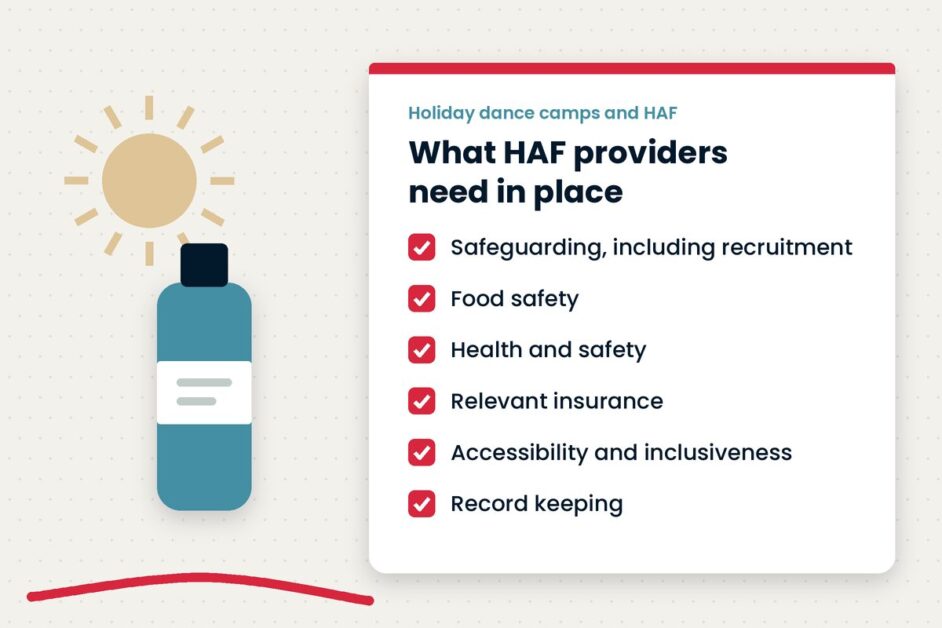
All HAF providers, including private providers, must be able to show the local authority they have relevant and appropriate policies and procedures for:
- safeguarding, including recruiting staff and volunteers
- food safety
- health and safety
- relevant insurance
- accessibility and inclusiveness
- record keeping.
Ofsted notes that both registered and exempt clubs can take part in HAF. It says HAF providers are responsible for understanding whether they need to register, and suggests working with your local authority to decide. Contact your council’s HAF team to find out how and when they recruit providers.
Planning a camp that families love
The best camps feel like a mini show week. Pick a theme, plan a short routine you can teach in the time, and finish with a sharing for parents. Build in water breaks, a proper lunch break and a calm space for anyone who needs a rest.
Think about your ratios, your registers and who will collect each child. Share your photography and first aid plans with families before the first day too. Our guide to photos, videos and consent covers the photography side. For seasonal inspiration, our Teach.Dance Halloween and Christmas class ideas work well for October and December camps.
Quick FAQ
Do I need Ofsted registration for a dance only holiday camp?
Not usually, if you offer tutoring or coaching in one or two of the listed activities to children aged 3 and over. The conditions must be met too. Check Ofsted’s registration exemptions guidance for your setup.
Can parents pay for my camp with Tax-Free Childcare?
Only if you’re an approved, registered provider signed up to the scheme. If you’re exempt, joining the voluntary part of the Childcare Register is the only way to register.
Can a private dance school deliver HAF?
The DfE’s guidance lists private providers among the organisations involved in delivering HAF. Speak to your local authority about how it commissions holiday provision.
What should I do before opening bookings?
Write down your activities, ages and daily hours, and check them against Ofsted’s exemption conditions. If you’d like to deliver HAF, speak to your council’s HAF team too.
Teach.Dance · For Teachers, By Teachers






Responses