
Growth spurts in young dancers: what dance teachers can do

Picture a dancer who comes back after the summer holidays a few centimetres taller. Some of her favourite steps suddenly feel different. Growth spurts in young dancers, rest and flexibility are all part of everyday teaching. Looking after them well keeps dancers healthy, confident and in class for years.
We’ve gathered some practical ideas for class here, backed by NHS guidance and resources from One Dance UK. This is general guidance, not medical advice. If you’re worried about a dancer’s health or an injury, encourage their parent or carer to speak to a GP, a pharmacist or NHS 111.
How much activity young dancers need
The NHS physical activity guidelines for children and young people are a good place to start. They say 5 to 18 year olds should aim for at least 60 minutes of moderate or vigorous activity a day. That’s an average across the week. Dancing is one of the NHS examples. The guidelines also recommend a variety of activities across the week to develop movement skills, muscles and bones.
It’s a helpful point to share with parents. A dancer who also swims, cycles or plays football is getting the variety the NHS talks about. For children and young people living with a disability, the NHS suggests aiming for 20 minutes of activity a day. That can be split into smaller chunks if needed. It also suggests challenging but manageable strength and balance activities 3 times a week.
The NHS also advises that children do exercise suitable for their age, ability and experience. It suggests starting anything new slowly, building up bit by bit. That fits naturally with how we plan progressions, especially at the start of term or when a dancer moves up a grade.
Growth spurts and growing pains
Parents often ask about growing pains. The NHS page on growing pains says they’re common in children aged 3 to 12, harmless, and usually get better on their own. The pain is usually an ache in both legs in the evening or at night, gone by the morning. Despite the name, the NHS says growing pains aren’t caused by growing. They’re more common in active children, and in children with very flexible joints.
The NHS suggests seeing a GP in some cases. Examples include pain in one leg or one joint, pain in the morning or during activities, or pain bad enough to cause a limp. If a dancer mentions pain like that, let their parent or carer know and suggest they get it checked.
If you’d like to go deeper, One Dance UK has a short recorded session for members on growth and maturation in young dancers. It’s led by Dr Siobhan Mitchell of the University of Exeter. It looks at what growth and maturation are, and how dance teachers can support healthy development.
Rest is part of good training
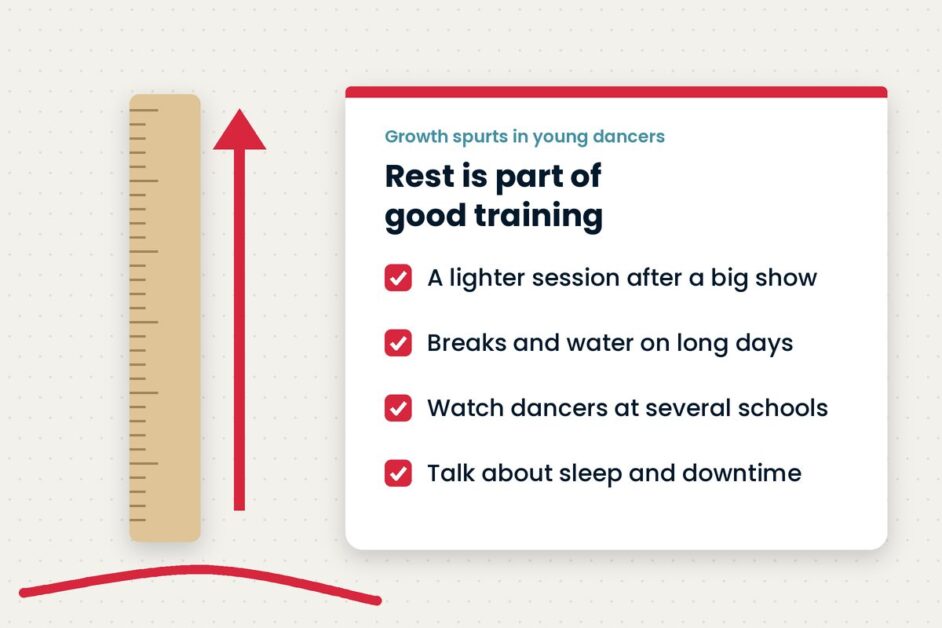
In studio life, rest matters most at our busiest times: show week, competition season, or a holiday intensive straight after exams. A few simple habits help:
- plan a lighter session after a big show or competition weekend
- build breaks and water into long rehearsal days
- keep an eye on dancers who take lots of classes across different schools
- talk with dancers and parents about sleep and downtime as part of training.
Picture show week. Water breaks are built into the long dress rehearsal, and you remind dancers and parents that sleep is part of the plan. Then the Monday after the show is a lighter session.
One Dance UK has a session on why dancers need rest, led by Professor Matthew Wyon of the University of Wolverhampton. It looks at burnout and its symptoms, how to recover, and how to build rest into dance training.
Warm-ups, cool-downs and safe stretching
Warm-up time is worth protecting, even when a rehearsal is running short. The NHS page on sprains and strains lists not warming up before exercise, and tired muscles, among the common causes.
One Dance UK’s session on warming up and cooling down introduces what a good warm-up and cool-down should involve. It covers safe and effective stretching, along with gradual progression, specificity and individuality. In class, that can be as simple as building up gradually and warming up the movements you’re about to use. Let each dancer work within their own range too.
Very flexible dancers
Lots of young dancers are naturally very flexible. One Dance UK has a guide for teachers, Managing joint hypermobility. It explains that joint hypermobility (a larger than average range of movement at a joint) is common among dancers. Through exercise and good technique, it says, hypermobile dancers can strengthen their muscles and control their range while still making the most of their lines. The guide includes training ideas on imagery, proprioception, posture and endurance.
The NHS page on joint hypermobility syndrome says the main treatment is improving muscle strength and fitness so the joints are better protected. Its advice includes not overextending your joints just because you can. In class, that means praising control and strength as much as range.
The NHS lists symptoms such as frequent sprains and strains, and repeated pain and stiffness in the joints or muscles. If you notice signs like these, have a quiet word with the parent or carer. The NHS suggests seeing a GP.
When a dancer gets hurt
A clear first aid plan helps everyone feel confident, from your class assistants to the chaperones at a competition. The Health and Safety Executive’s first aid guidance covers first aid at work, including what employers need to know.
For sprains and strains, the NHS describes PRICE therapy for the first 2 to 3 days: protection, rest, ice, compression and elevation. It advises getting help from NHS 111 if the injury is very painful or there’s a lot of swelling or bruising. The same goes if the person can’t put weight on it or walk more than a few steps.
The National Institute of Dance Medicine and Science (NIDMS) is useful for dancers who train seriously. It has information on NHS Dance Injury Clinics in London, Birmingham and Bath. They’re free at the point of use and need a GP referral. NIDMS describes them for professional or pre-professional dancers, dance teachers and choreographers. It says it currently can’t accept referrals from GPs in Scotland, Wales or Northern Ireland.
Your own body matters too. Our post on taking care of your body as a dance teacher has more on that.
Wellbeing and safeguarding go together
Looking after dancers’ bodies sits naturally alongside safeguarding. Both put children’s welfare first, and both build parents’ trust in your studio. Here at Teach.Dance, our Introduction to Safeguarding in Dance (Level 1) course is a short online refresher for you and your team. It looks at spotting concerns, responding and reporting, and safer practice. For more on welcoming every dancer, have a look at our guide to creating an inclusive dance space.
Quick FAQ
Should young dancers stretch to their limit?
The NHS advises people with very flexible joints not to overextend them just because they can. One Dance UK’s guidance focuses on strength and control for hypermobile dancers. Building range alongside strength is a good focus for class.
A dancer says her legs ache at night. Is that growing pains?
It might be, but it’s not for us to diagnose. The NHS lists signs that mean a GP visit is a good idea. These include pain in one leg, pain in the morning or a limp. Share what you’ve noticed with the parent or carer.
How much dance is too much?
There’s no single answer for every dancer. The NHS recommends a variety of activities across the week. One Dance UK’s resources on rest and burnout are a good place to learn more. Watch for tiredness, and plan rest around busy show and competition periods.
What’s one thing I can change this term?
Protect warm-up time in every class, even in show week. It’s one of the simplest habits in this guide, and the NHS links not warming up to sprains and strains.
Teach.Dance · For Teachers, By Teachers




Responses