
If you’ve ever swept a church hall floor before your Saturday baby ballet class, this one’s for you. Arts Council England has published its first national study of the private dance school sector. It puts real numbers on the things many of us deal with every week: rent, rising costs and families on tight budgets.
The research was commissioned by Arts Council England and carried out by the University of Bedfordshire. There’s also a short read for dance teachers, schools and studios that sums up the main findings. We shared the headlines in our 2 October news round-up. Here, we look at what the findings mean for your school.
A big sector with deep roots
The national mapping identified 5,229 active dance providers in England. The provider survey produced 316 usable responses. Some very small or informal classes won’t have been found, so the study offers “a clear baseline rather than a complete record”.
What stood out to us is how established we are. More than three quarters of survey respondents had been operating for over 10 years. Almost half had been providing dance for more than 20 years. Most provision is in urban areas: around 88% of mapped providers were in urban locations, compared with around 12% in rural areas.
Space is a challenge for most of us
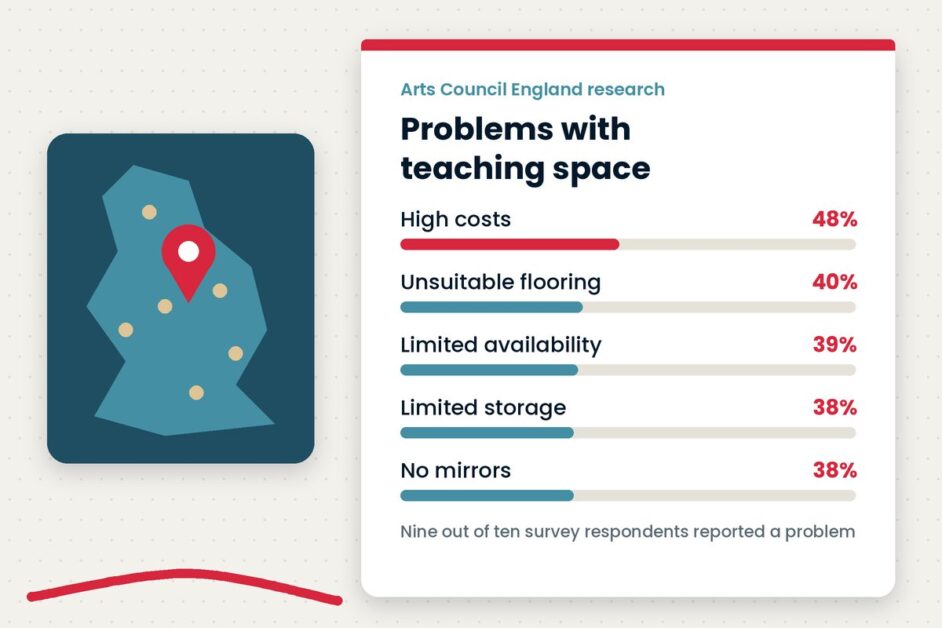
Most providers don’t own the places where they teach. 59% of survey respondents rented teaching space by the hour or session. Nine out of ten survey respondents reported some kind of problem with their teaching space. The most common issues were:
- 48% high costs
- 40% unsuitable flooring
- 39% limited availability
- 38% limited storage
- 38% no mirrors
Anyone who has taught tap in a hall without mirrors will recognise that list. The research points out that space affects the quality and safety of what we offer, and how much families pay.
Looking at a new hall? Our checklist for choosing a new dance class venue covers the floor, fire exits, electrics, toilets and insurance.
Money pressures, and how we’re already helping
Only 5% of survey respondents said they were not affected by financial pressures. The biggest issue was the rising cost of living for families. Providers were also dealing with increases in venue costs, teachers’ pay, insurance, costumes and productions, materials, examinations and utilities.
Many teachers described trying not to pass these costs on to families. Around 10% of respondents said they felt their organisation was at risk of closure in the following 12 months.
The good news? We’re already doing a lot to keep dance within reach. Survey respondents offered:
- free taster sessions
- discounts and payment plans
- loaning or reusing uniforms
- subsidised classes, scholarships and bursaries
- lower-cost non-exam classes
- partnerships with schools or community groups
Much of this support comes from schools themselves, and only a minority of survey respondents reported receiving grant or public funding. Thinking about tasters? Our guide to trial classes and welcoming new families is a good place to start.
Helping dancers find their next step
The research found that private dance schools are an important part of progression. This matters more “in a context where specialist dance provision in statutory education has declined”. Many of us prepare students for auditions, vocational schools, Centres for Advanced Training (CAT) and conservatoires.
However, awareness of progression routes varies considerably. Teachers asked for clearer information about different routes, better links with colleges and conservatoires, and help with costs such as travel and auditions. The short read puts it simply: young people shouldn’t need to already understand a complicated system to access opportunities.
A simple step is to keep a list of routes near you, such as youth dance companies, local colleges and your nearest CAT, and share it with families. Our guide to helping your dancers with next steps has more ideas.
Inclusion and boys in our classes
Many providers adapt their teaching to meet different needs, with predictable routines, sensory adjustments, quiet spaces, visual supports and awareness of cultural and faith needs. Even so, only a relatively small proportion of mapped providers were explicitly identified as offering inclusive or disability-focused provision. The research sees a chance to build on this through training and shared learning.
Boys and young men remain underrepresented in some parts of dance. Teachers mentioned stereotypes, peer pressure and family attitudes. But the picture changes with the style. Street, hip hop, breaking and some culturally specific forms were reported as attracting more boys and young men. The research suggests recognising and supporting the dance forms that boys are already choosing.
Recognition, qualifications and safeguarding
The most common answer to what would strengthen the sector was recognition. 62% of survey respondents said increased visibility and recognition of private dance schools, studios and groups would strengthen the sector. Many felt private dance is still too often seen as simply a hobby or leisure activity.
Teachers also want practical support. The most commonly identified areas were:
- 43% support with venue costs
- 33% investment in equipment or space
- 29% stronger partnerships with schools and education
- 22% support for bursaries
- 18% teacher development
Here’s a really positive finding. Many people who contributed to the research wanted high standards of teaching and safeguarding across the sector. There was concern that parents don’t always have a simple way of understanding whether a teacher has appropriate training. The research recommends exploring clearer information about recognised teaching qualifications, accessible professional development and safeguarding training.
While that work develops, here’s our own suggestion, not something the research mentions. Our partner, the British DanceSport Association (BDSA), runs the National Dance Safe Register, a public register of UK dance schools. Any UK dance school can be listed for free, and if your school is already listed, you can claim it. Accredited schools are assessed against BDSA’s Safe Dance Standard, which includes Enhanced DBS and Children’s Barred List checks, child protection policies and first aid requirements. BDSA says the register is there so parents and guardians can have confidence in the school. For your own team, our free BDSA safeguarding training is a good next step.
What happens next
The short read suggests actions for the sector to consider. They include a stronger national voice, easier teacher development and simpler funding. Help with space costs, clearer progression information and stronger links with schools are on the list too. You’ll find the full report and the interactive map on Arts Council England’s private dance schools research page.
Arts Council England says its next step is to listen. It will work with the External Reference Group, providers and the wider sector to identify where future work could make the greatest difference. The research also flags gaps, such as rural provision and why some young people stop dancing.
Your next steps
A few simple things to try this term:
- Read the short read and look up your area on the interactive map.
- Check your teaching space against the venue checklist.
- Review how you help families with costs, from tasters to payment plans.
- Make a list of local progression routes to share with older students.
- Check your school’s listing on the National Dance Safe Register.
This research is a first step, and it’s good to see our work counted. We give children far more than dance steps, and now there’s evidence to back that up.
Teach.Dance · For Teachers, By Teachers






Responses