
The tinsel is up in the hall, the running order is taped to the wall and a lovely parent has offered to run a bar in the interval. Mulled wine for the grown ups, squash for the dancers, mince pies all round. Before anyone warms the first pan, it’s worth a quick look at the rules on alcohol at your Christmas show.
Just to be clear, this post is about the venue and the bar, not your performers. If children are performing in your show, they may need a child performance licence, or your school may need a BOPA (Body of Persons Approval) from the council. That’s a separate set of rules, and our guide to dance school shows and BOPA explains when they apply.
On the venue side, the good news is that most dance school shows need far less than people think. Under entertainment licensing, the dancing on stage usually doesn’t need a licence for the venue. The bar is the bit that needs sorting, and that’s quick and cheap if you start early. Here’s how it works in England and Wales.
Does the venue need an entertainment licence for the show?
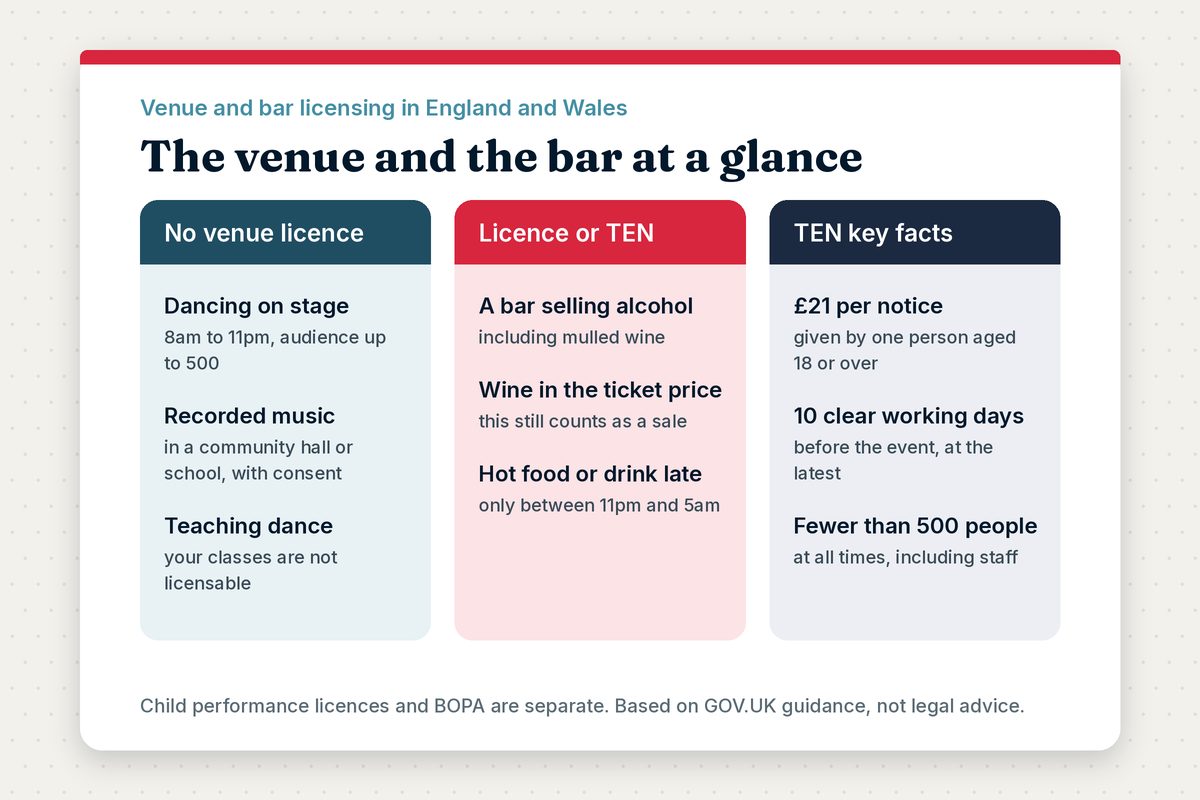
Usually not. This is entertainment licensing for the venue, and the rules sit in the Licensing Act 2003, and the GOV.UK guide to entertainment licensing says no licence is needed for a performance of dance between 8am and 11pm, for an audience of no more than 500. Most dance school shows sit comfortably inside that.
Your weekly classes are fine too. The Home Office guidance issued under section 182 of the Licensing Act 2003 lists teaching students to dance as an example of entertainment that isn’t licensable.
What about the music? The same guidance says playing recorded music needs no licence between 8am and 11pm in a church hall, village hall or community hall, for an audience of up to 500. The catch is that you need consent from the person responsible for the hall. There’s a similar rule for school premises, where the school gives consent. We’d simply ask the hall manager and get a yes in your hire agreement.
This is entertainment licensing, which is separate from copyright. Paying for the music itself is a different question, and our guide to the music licence for dance classes covers it.
Booked a theatre? The venue will usually hold its own premises licence. Ask what it covers, including the bar, and who runs it on the night.
Selling drinks is the bit that needs a licence
Selling alcohol is a licensable activity. If your hall doesn’t have a premises licence that covers alcohol, you’ll need a Temporary Event Notice, usually called a TEN. The GOV.UK page on temporary events notices explains that a TEN covers a one off event on unlicensed premises in England or Wales.
A glass of wine included in the ticket price is still a sale. East Devon District Council’s guide for village halls says a premises licence or a TEN is needed where “free” alcohol comes in the price of a ticket. Calling it free doesn’t change the rules.
Mulled wine is covered by the same rules, because a hot drink containing alcohol counts as alcohol. Hot chocolate and mince pies are fine at an early evening show. Hot food and drink only needs a licence between 11pm and 5am, and we’ve never known a dance show run that late.
How a TEN works
Here are the main rules from the GOV.UK page, in plain words:
- You apply to your council, usually online, and the fee is £21.
- Apply at least 10 clear working days before the event. That doesn’t count the day the council gets it or the day of the event itself.
- There must be fewer than 500 people at all times, and that includes staff.
- The event can last no more than 168 hours, which is far longer than any show.
- You apply as an individual, not as a dance school, and you must be 18 or over.
- You can give 5 TENs a year, or 50 if you hold a personal licence.
- A single premises can have 15 TENs a year, covering no more than 21 days in total.
- Keep the TEN at the venue and display a copy where people can see it.
That under 500 figure catches dance schools out. It isn’t just the audience. Count your dancers, chaperones, helpers, front of house and anyone on lights and sound too. A full hall can creep closer to the limit than you’d expect.
Timing matters. For a show on Saturday 12 December, 10 clear working days takes you back to Monday 30 November, so the council needs your TEN by Friday 27 November at the latest. We’d send it in as soon as your date is fixed and avoid the stress.
Missed it? A late TEN can be given between 5 and 9 clear working days before. Without a personal licence you can only give 2 late TENs a year. If the police or environmental health object to a late TEN, it isn’t valid and you can’t hold the event under it.
For any TEN, the police and environmental health have 3 working days to object. One of the reasons they can object is if they think the event could put children at risk of harm. That’s one more reason to plan the bar carefully at a show full of young dancers.
Raffles, tombolas and a bottle of fizz
Bottles of wine are a favourite raffle prize. Section 175 of the Licensing Act 2003 says an incidental lottery with alcohol as a prize isn’t a licensable activity, as long as the alcohol is in a sealed container. You can read section 175 on legislation.gov.uk.
The raffle itself still has to follow the incidental lottery rules, such as selling tickets only at the show. Our guide to dance school raffle rules walks you through them.
Keep the bar well away from backstage
A show night is still a dance school night, and your safeguarding comes first. GOV.UK’s page on alcohol and young people confirms it’s against the law to sell alcohol to anyone under 18. Your older students can still help out, just give them jobs such as programmes, raffle tickets or front of house rather than the bar.
Put the bar somewhere well away from the dressing rooms, the stage door and the route dancers use. Make sure the person running the bar isn’t also chaperoning. We’d also suggest a simple rule that nobody on chaperone duty drinks at all that night.
As we said at the start, child performance licences and BOPA are a separate subject from the bar, and just as important to get right. Our guide to dance school shows and BOPA explains when they apply and how chaperoning works.
If you’d like a refresher before show season, the free Safeguarding in Dance Level 1 course is a BDSA course powered by Teach.Dance, with BDSA as our endorsing and co-branding partner. It takes you through the basics of keeping dancers safe.
Fire safety and the venue
Licensing is only one part of the picture. The section 182 guidance reminds organisers to follow other laws too, such as fire and health and safety. GOV.UK’s guide to fire safety responsibilities explains that the person in control of premises must carry out a fire risk assessment, and that when there’s more than one responsible person they have to work together.
So ask the venue for its fire safety arrangements, its capacity and its evacuation plan. Then brief your chaperones on exits and meeting points before the doors open. Our dance class venue checklist has more questions worth asking.
Scotland and Northern Ireland
Everything above applies to England and Wales. Scotland and Northern Ireland have their own licensing systems, so talk to your local council’s licensing team before you plan a bar.
Your Christmas show bar checklist
- Check separately whether your performers need child performance licences or a BOPA.
- Check the show finishes before 11pm and the audience is no more than 500.
- Get the hall’s consent for recorded music, ideally in your hire agreement.
- Ask whether the venue already has a licence that covers a bar.
- If not, decide who will give the TEN and send it in as early as you can.
- Count everyone in the building, not just the audience.
- Keep alcohol prizes sealed and sell raffle tickets only on the night.
- Keep the bar away from backstage, and keep chaperones off the bar.
- Ask the venue about fire safety and brief your team.
This is general guidance, not legal advice. Councils can differ in how they handle the details, so if you’re unsure, give your council’s licensing team a call. They’re usually very helpful.
Enjoy the show
A Christmas show is one of the best nights of the dance school year. Sort the bar early, keep it away from your dancers, and you can spend the evening watching the stage instead of worrying about the rules.
Teach.Dance · For Teachers, By Teachers





Responses