
Contemporary is the class where dancers learn to breathe, fall, roll and make their own movement. It can feel daunting to teach if you trained mostly in ballet, tap or jazz. It doesn’t need to be. These contemporary dance class ideas are simple to set up, work from juniors to adults, and give your dancers a real feel for the style.
Pick one idea from each section and you have a full class. Keep the rest up your sleeve for next week.
Where contemporary movement comes from
A little history helps dancers understand why contemporary feels so different from ballet. Britannica’s profile of Martha Graham describes her technique as built on contraction and release, centred in the pelvis. It became the first significant alternative to classical ballet.
Doris Humphrey explored a different idea. Britannica’s profile of Doris Humphrey explains her theory of fall and recovery. It’s the play between balance and imbalance, as the body gives in to gravity and then recovers. Those two ideas still sit at the heart of many contemporary classes today.
We’ve already looked at the difference between contemporary and lyrical, so this post sticks to what to actually teach on a Thursday night.
Start with breath and the spine
Contemporary starts from the inside. Begin with dancers sitting or standing in parallel, eyes soft, and simply breathing together. Ask them to notice where the breath moves: ribs, back, belly.
Breathe and curve
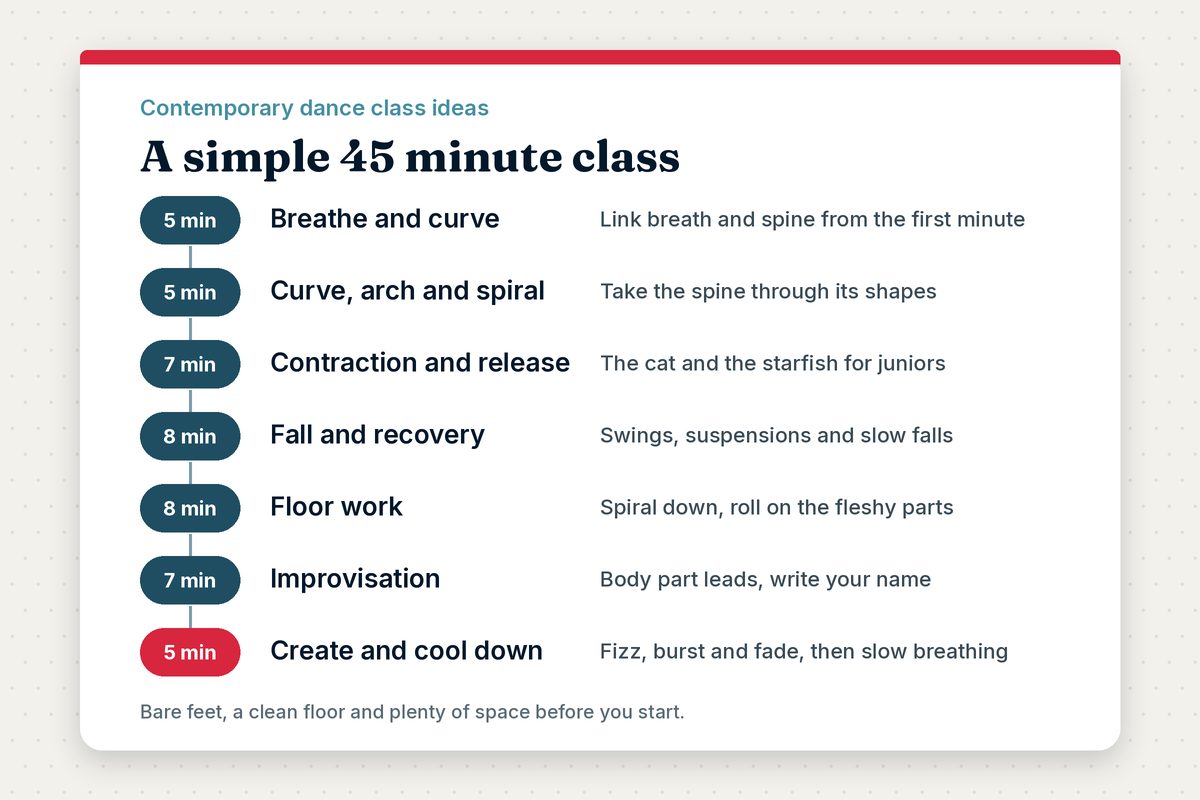
On a slow inhale, dancers lengthen up through the spine. On the exhale, they curve forward from the top of the head, one bone at a time. Repeat four times, then add the arms. It warms the back gently and teaches dancers to link breath and movement from the very first minute.
Curve, arch and spiral
Next, take the spine through its shapes. Curve forward, lift through the chest into a gentle arch, then twist into a spiral around the centre line. Keep the arch small and lifted, never crunched in the lower back. Call each shape out loud so younger dancers can follow.
Contraction and release for every age
Teach the contraction as an exhale that hollows the stomach and rounds the back. Imagine someone has gently pushed you in the tummy. The release is the inhale that brings the spine back to long and tall.
For juniors, try the cat and the starfish. Sitting cross legged, dancers curl into a round, scared cat on the exhale. On the inhale, they open into a wide, happy starfish. Seniors can take the same idea standing, then travel it across the floor with a step on every release.
Fall and recovery: playing with gravity
This is where contemporary really starts to fly. Start with simple swings. Dancers let the arms drop and swing with gravity, then suspend at the top for a moment before they drop again. Count it as “drop, swing, and hold”.
Then build to whole body falls. Dancers lean slowly off balance in one direction, then step out at the last moment to recover. Try forwards, sideways and on a diagonal. Start slow and low, and only add speed when the class is in control.
Floor work: into the floor and out again
Floor work is a big part of contemporary, but it’s all about how dancers get there. Teach them to spiral down to the floor through the legs and hips, then roll across the fleshy parts of the back and shoulders. Avoid landing on knees, elbows or the bony points of the spine. If you’ve already taught our modern dance class ideas, the safe rolls from that class make a great starting point.
- Bare feet. Contemporary is usually danced barefoot. One Dance UK’s dance in schools footwear resource looks at why bare feet matter in dance lessons.
- Check the floor first. Sweep it, look for splinters and make sure it’s dry.
- Cover the knees. Long, close fitting leggings or kneepads help with floor work, especially for beginners.
- Know your space. One Dance UK’s Industry Standards call for a clean, suitably sprung floor and enough room to move safely.
Improvisation games that feel safe to try
Many dancers freeze when you say “improvise”. Give them a clear task, a time limit and plenty of company, and the nerves soon fade.
Body part leads
Call out a body part, such as an elbow, the top of the head or a knee. That part leads the dancer around the room, pulling the rest of the body behind it. Change every eight counts. Everyone is moving at once, so nobody feels watched.
Write your name
Dancers write their name in the air with a hand, then a foot, then the hip, then the whole body. Ask for one letter big and one tiny. Suddenly they have a phrase of their own, with no steps to remember.
Stillness and go
Only three dancers can move at any time. When one stops, someone else must start. It builds awareness of the group and teaches dancers to use stillness as part of the dance.
Weight sharing, with consent
Weight sharing builds trust and teaches dancers to give and take weight safely. Start with something simple: back to back, breathing together, then sliding down to sit and pushing back up as a pair. Next, try palm to palm, leaning in and taking a little of each other’s weight.
Always ask before any contact work, explain exactly what will happen, and offer a no touch alternative. Pair dancers of a similar size and age, and keep everything you teach in full view of the room. If you need to correct a dancer, start with words and demonstration, and only touch with permission.
This is good safeguarding, and it helps families trust your classes. Our partner BDSA has a free online course, Introduction to Safeguarding in Dance (Level 1), powered by Teach.Dance. It’s an easy refresher for everyone who teaches or assists.
A Bonfire Night creative task
This week is Bonfire Night, so let’s use it. Give small groups three words: fizz, burst and fade. Each group makes a short phrase for each word, then joins them together.
- Fizz: small, quick movements close to the body, like a sparkler.
- Burst: one big explosive jump or reach that fills the space.
- Fade: slow, falling movement that melts all the way to the floor.
Once each group has its phrase, try it in canon, or ask one group to perform while the others become the crowd watching the display. It ties together everything from the class: breath, falls, floor work and making their own material.
Music, silence and sound
Contemporary doesn’t always need a strong beat. Try piano, strings or ambient soundscapes for floor work, and a steady track with a clear pulse for travelling. Now and then, take the music away completely. Dancing in silence makes dancers listen to their own breath and to each other.
Whatever you play in class, check that your music licence for dance classes covers it.
Thinking about graded contemporary?
If your dancers would like exams, Rambert Grades offers graded contemporary dance exams for ages 3 and over, starting with Creative Movers, Pre-Primary and Primary. Its Grades 1 to 8 in Creative Contemporary Dance each cover three strands: technical, performance and creative. It’s well worth a look if you’d like a structured route alongside your own classes.
Keep an eye on dancers going through a growth spurt, especially in floor work and falls. Our guide to growth spurts in young dancers explains what to look out for.
Let them find their own way
The best contemporary classes feel calm, brave and full of ideas. Start with the breath, build every fall from a small one, and give dancers time to make their own movement. Do that, and you’ll see confidence grow in dancers who never thought contemporary was for them.
Teach.Dance · For Teachers, By Teachers







Responses