
Bare feet on a sprung floor, plenty of space and a track with a strong beat. Modern is often the class where dancers really start to move big. These modern dance class ideas are the ones we lean on to keep that energy safe, strong and expressive, from juniors right through to adults.
What we mean by modern
For many UK dance schools, modern sits somewhere between ballet and jazz. It keeps strong technique and clean lines, then adds swings, falls, spirals and big travelling steps. It isn’t the same as contemporary, although the two share plenty.
If your timetable mixes styles, our post on the difference between contemporary and lyrical is a good companion read. And if you teach graded work, you’ll often find modern and jazz side by side. UKAdance, for example, calls its graded syllabus Modern Jazz.
A simple shape for a 45-minute modern class
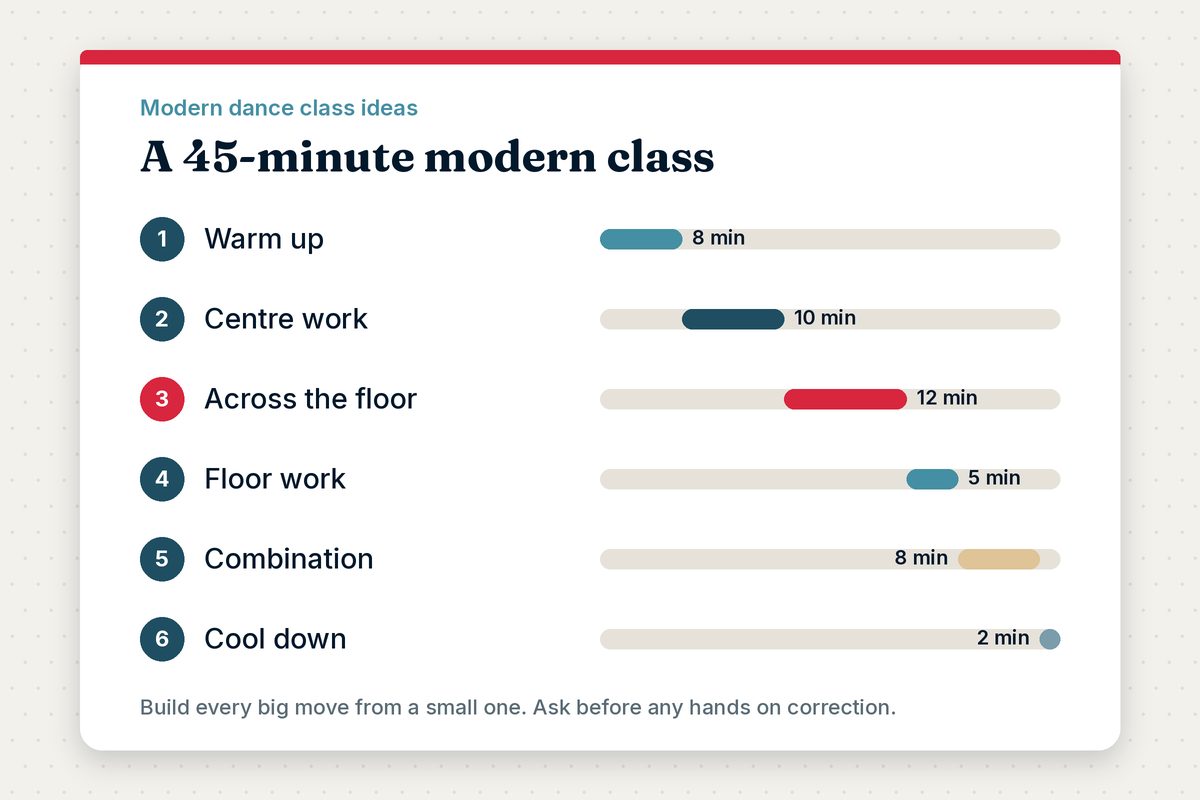
This structure works well for most junior and senior classes:
- Warm up (8 minutes). Raise the pulse, then add swings, roll downs and gentle mobility. Build from small to big.
- Centre work (10 minutes). Parallel and turned out work, isolations, balances and simple turns.
- Across the floor (12 minutes). Travelling steps, runs, turns and jumps in lines or small groups.
- Floor work (5 minutes). Rolls, slides and safe ways to go down and come up.
- Combination (8 minutes). A short routine that pulls the class together.
- Cool down (2 minutes). Slow breathing and gentle stretches.
Warm ups that suit modern
Modern asks a lot of the spine, hips and feet, so the warm up should too. Start with marching or easy jogs to lift the heart rate. Then move into arm swings, body swings and slow roll downs through the spine. Finish with parallel pliés and rises, so feet and ankles are ready for travelling.
Keep stretches gentle at this stage and save longer stretches for the cool down, when muscles are warm. One Dance UK’s Healthier Dancer Programme has information sheets on topics including warm up and cool down. It’s well worth a look for your whole teaching team.
Across the floor ideas
Runs and leaps
Start with low, soft runs in parallel, then add a small leap on every fourth step. Count it out loud: “run, run, run, leap”. As dancers get stronger, lengthen the leap and ask for a soft, quiet landing through the feet.
Swing and travel
Teach a body swing on the spot, then take it across the room. Swing, step, step, swing. It shows dancers how to use momentum, which is at the heart of so much modern movement.
Turn tracks
Mark a straight line on the floor with tape. Dancers practise a simple turn, such as a step turn or a chaîné, along the line. Give them one clear spot on the far wall, and slow the music down until the turns are neat.
Copy the shape
One dancer travels across the room and freezes in a shape. The next dancer travels and finishes in a shape that links to the first. By the end, the whole class has built a sculpture together. It’s lovely for creativity, and for shy dancers who would rather show than tell.
Floor work, done safely
Floor work is where modern really comes alive, but it needs building carefully. Teach dancers to go down and come up through their hands, knees and hips, never by dropping. Start with simple rolls and slides before anything faster or higher.
Keep an eye on dancers who are going through a growth spurt. They may suddenly feel less coordinated or less flexible than they did last term. Our guide to growth spurts in young dancers explains what to look out for and how to adapt.
If you need to make a hands on correction, ask first and explain what you’re going to do. Lots of us now start with words and demonstration, and only touch with permission. It’s simple good practice that keeps dancers safe and helps parents trust your classes.
Our partner BDSA has a free online course that covers good practice like this. Introduction to Safeguarding in Dance (Level 1) is powered by Teach.Dance and makes a great refresher for your whole team.
Creative tasks to finish the class
Modern is a brilliant style for letting dancers make their own movement. Try one of these in the last ten minutes, or swap it in for the combination now and then.
- Word to movement. Give three words, such as “melt, reach, spin”, and ask small groups to make a phrase.
- Mirror and canon. Pairs copy each other, then perform the phrase one count apart.
- Change the dynamic. Dance the same eight counts sharp, then smooth, then heavy.
- Build a motif. Each dancer adds one move to a group phrase until it’s 16 counts long.
Music for modern
Modern works with a huge range of music, from piano and strings to pop and film soundtracks. Try something slow for floor work and a strong, driving beat for travelling. Changing the music for the same phrase is a quick way to teach dynamics, too. Whatever you play, check your music licence for dance classes covers it.
Moving towards graded modern
When your dancers are ready for exams, the UKAdance Modern Jazz Grades 1 to 3 course on Teach.Dance covers the full syllabuses for those grades. You get syllabus videos with music, full run throughs, downloadable music and scripts, and the complete PDF syllabuses.
You can use it in your browser or the free Teach.Dance app, and it includes access to the UKAdance Theatre Community group. If you teach every level, the UKAdance Modern Jazz Grades 1 to 8 bundle brings all eight grades together.
UKAdance was the first dance association to join Teach.Dance, and you can read more in our post on UKAdance joining Teach.Dance. When exam day arrives, our guide to helping dancers with exam nerves will help everyone feel ready.
Keep it moving
The best modern classes feel big, bold and safe. Build every big move from a small one, give dancers room to create, and celebrate the moment a tricky floor sequence finally flows. Keep the warm up thorough and the corrections kind, and your dancers will love coming back each week.
Teach.Dance · For Teachers, By Teachers








Responses