
It’s 3.40pm on a Thursday in January. Snow has been falling since lunch, the roads are slow and your phone is already buzzing. “Are we still dancing tonight?” A simple dance school winter weather plan means you can answer calmly, quickly and the same way every time.
The clocks go back on Sunday 25 October, and the stormy months aren’t far behind. October half term is a good moment to sort this out, while the weather is still kind. It only takes an evening, and parents really notice when a school handles a snow day well.
Decide who makes the call, and by when
The hardest bad weather days are the ones where nobody’s sure who decides. Pick one person to make the call for each venue. For most of us that’s the principal, with a named back up for anyone teaching at another hall.
Then set a deadline. Something like “we’ll confirm by 2pm on the day” works well. It gives families time to plan, and it stops the steady trickle of messages asking if you’ve decided yet.
Use the Met Office warnings as your guide
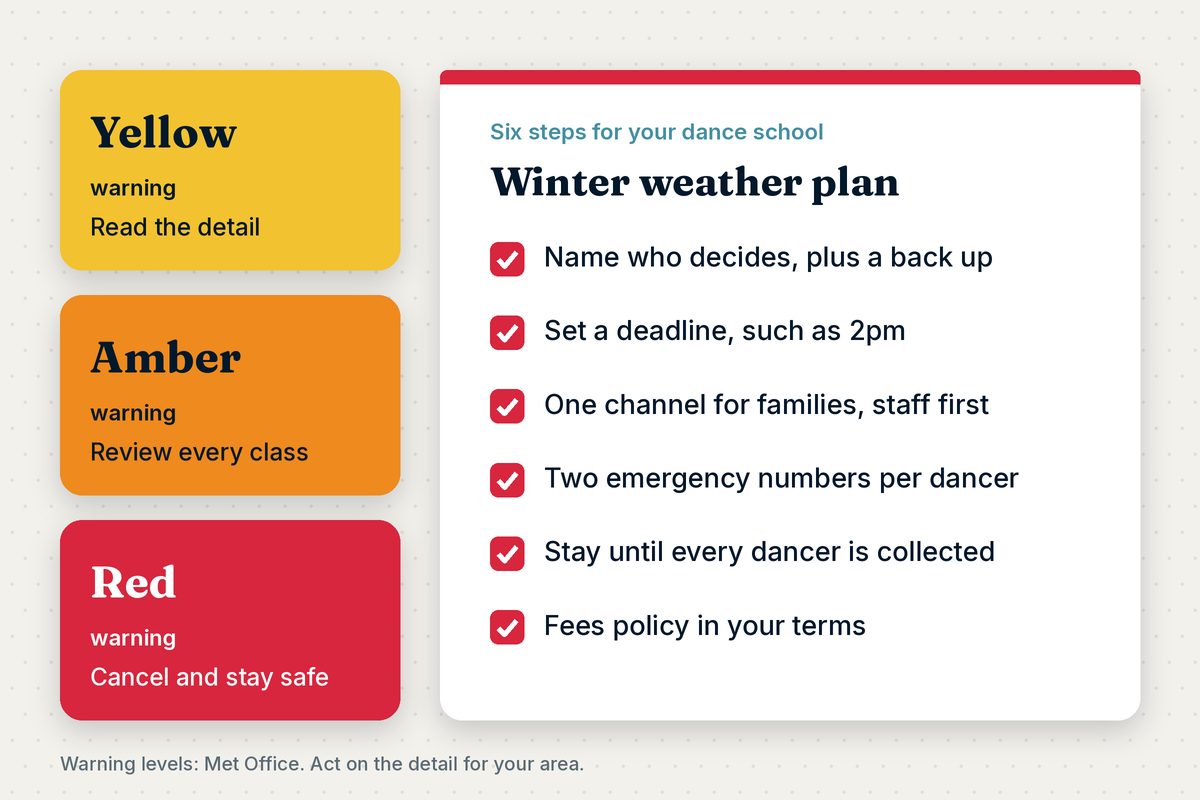
The Met Office guide to weather warnings explains what the three colours mean. Yellow warnings cover a range of situations, so it’s important to read the detail and check whether you could be affected. Amber means an increased likelihood of impacts that could disrupt your plans, such as travel delays, road closures and power cuts. Red means dangerous weather is expected, and you should act now to keep yourself and others safe.
A simple rule of thumb helps. Carry on under yellow unless the detail affects your area, look hard at every class under amber, and cancel under red. Make it your own, though. A short drive across town isn’t the same as a village hall at the top of a hill.
From 1 November, the UK Health Security Agency and the Met Office also issue cold health alerts. They’re aimed at health and care teams, but anyone can register to get them by email. They’re a useful early nudge if you teach older adults or run a daytime class for over 60s.
Tell families the same way, every time
Choose one main channel for weather news and stick to it. That might be your booking app, a class WhatsApp group or a text message. Post on social media as well if you like, but don’t rely on it alone.
Keep the message short and clear: which classes are off, what happens about fees and when you’ll be in touch next. Something like this does the job: “Because of the amber snow warning, tonight’s classes at St Mary’s Hall are cancelled. We’ll message on Monday with a catch up date.”
Tell your teachers and assistants first, though. Nobody wants to turn up to a cold, locked hall.
Never leave a dancer waiting at a closed door
This is the safeguarding part, and it matters most. If you cancel late, some families won’t see the message in time. So someone from your team should be at the venue at the usual start time until every dancer who turns up is safely collected. Ideally that is two adults, waiting somewhere warm and well lit.
That’s when up to date contact details really earn their keep. The Department for Education has safeguarding guidance for after school clubs, community activities and tuition. It says you should have more than one emergency contact number for each child. It also says to have an emergency plan, and to review your risk assessments at least once a year. Check your contact list now, before the first frosty evening.
Our guide to drop-off and collection on darker evenings covers registers and late collections in more detail. Our partner BDSA also has a short, free online course for your whole team. Introduction to Safeguarding in Dance (Level 1) is powered by Teach.Dance and makes a great refresher.
When class goes ahead: cold halls and wet floors
Plenty of wintry evenings end with class going ahead in a chilly hall. Dancers need a longer, gentler warm up when it’s cold, and nobody should be pushing deep stretches on cold muscles. Let them keep a layer on until they’re properly warm.
The Health and Safety Executive has guidance on workplace temperature. It says an indoor workplace should normally be at least 16°C, or 13°C if much of the work involves rigorous physical effort. That’s written for workplaces and staff, but it’s a handy benchmark for your team and your hall. If the heating hasn’t come on, ask the venue before you start.
Wet shoes are the other winter hazard. Put a mat and a towel by the door, ask dancers to change shoes inside and check the floor before class. Our dance class venue checklist has more questions to ask your hall. If someone does slip, our dance teacher first aid guide covers kits, first aiders and records.
And if the heating fails or the power goes off, it’s fine to call it. A short, safe class is better than a long, freezing one.
Fees, refunds and catch up classes
Parents will ask about money, so decide your answer before the first snow day. Some schools run a catch up class, some give a credit and some refund. Whatever you choose, write it into your terms and conditions so it’s clear and fair for everyone.
Our post on why terms and conditions matter for your dance school has example wording you can adapt. Being generous where you can builds a lot of goodwill. A bonus class in the holidays often goes down better than a small refund.
This is general guidance, not legal advice. If you’re unsure about refunds or your contracts with families, check gov.uk or get advice.
Your winter weather plan in six steps
- Name who decides for each venue, plus a back up.
- Set a deadline for the decision, such as 2pm on the day.
- Pick one channel for families, and tell staff first.
- Check emergency contacts, with more than one number for each dancer.
- Stay at the venue at the usual start time until every dancer is collected.
- Write down your fees policy for cancelled classes in your terms.
Share it before the first frost
Once your plan is written, send it to families in the first week back after October half term. Add it to your website and your welcome pack too. Then, when the snow does arrive, you’ll be the calm voice in the group chat rather than the last to decide.
Teach.Dance · For Teachers, By Teachers








Responses